
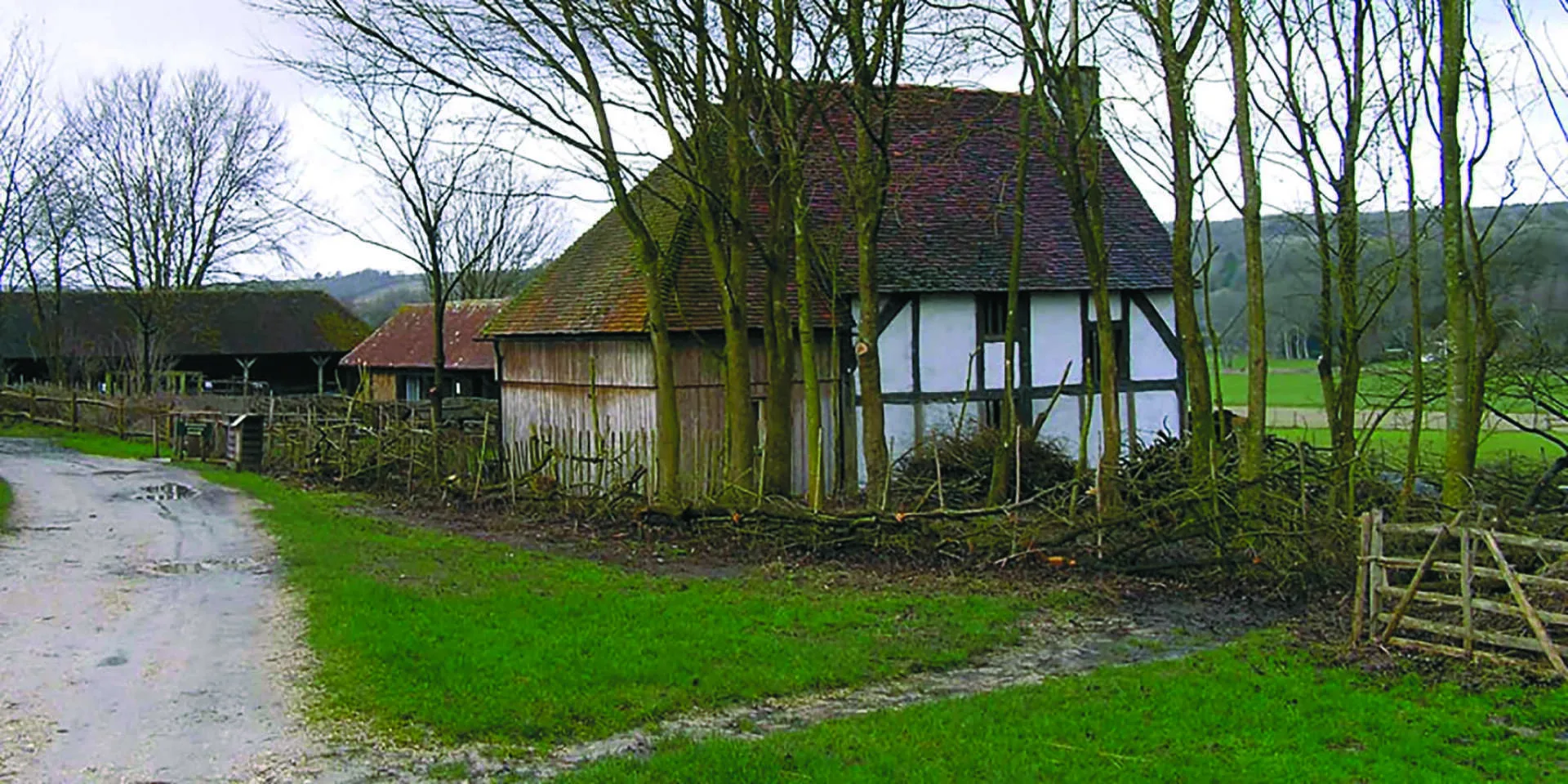
by Trevor Dale
A while ago we met the chap who had actually listed Cranleigh Cottage Hospital for the National Heritage List for England, way back in 1987. Eagerly we enquired what he thought of it. “Oh I didn’t stop, didn’t even get out of the car!” A drive-by listing then.
The official statement is ‘Hall house, extended and converted into a Village Hospital. Early C16, converted in 1859’ The entry number is 1044373.
The Domestic Building Research Group (DBRG) inspected the cottage in detail in 1975 and wrote a report declaring the property to be a three bay open hall house. In 2008 the DBRG added a dendrochronology report performed by a specialist. This took samples of the wooden structure declaring the felling date to be Winter 1445/6. It is hence assumed that the cottage was erected soon after as was the habit. So, not 16th century but mid 15th.
All well and good, but we have commissioned a fresh report from a highly qualified surveyor recommended by the Weald and Downland Museum at Singleton, near Chichester. He is also closely associated with the DBRG today.
The original report can be reassessed in light of current knowledge and understanding and additional information and interpretation can now be added, including the position of a formerly unknown window, for instance. It would be normal, in a residential house of this period, to have some simple form of decoration on the wooden structure, but there is none. Equally there is an absence of original windows facing what is now the High Street and no door to that side. There was a slim letterbox-style window high up on the West side which now faces the car park. It is surmised that this provided ventilation.
Without delving into intricate detail, the form of the cottage, and the presence of considerable soot encrusted on the roof timbers, leads to the conclusion that this was built as a kitchen to a house close by to the South. Probably where the current NHS Village Hospital has been built.
In the 15th century, the risk of fire from the cooking area was extremely high and so it is not unusual to have an entirely separate kitchen. To add to this conclusion is the pitch of the roof. At 42 degrees it is too shallow to have been thatched. The cottage seems to have had a tiled roof from the time of construction, adding to the evidence of it being a kitchen.
A very interesting and useful reference is the Winkhurst Tudor kitchen at the Weald and Downland living Museum. (See cover photo)
It must be stated that something is not a historical fact unless and until a historian writes about it and uses it to successfully support a hypothesis that is accepted by their academic peers.
Some time back, early in this project, Cranleigh Heritage Trust commissioned a specialist to trace the house history through the historic archives. He could get no further back than the early 1600’s. Having discussed the later modifications, like the addition of fireplaces and chimneys, they appear to date from this time. So perhaps what started out as a cooking place, became a residence, owned by St Nicholas church by early 1600’s and then became the first Cottage Hospital in England in 1859 and the foundation of the ethos of our NHS today.
From humble beginnings indeed.
FURTHER SUPPORT FOR THE PROJECT
Cranleigh Heritage Trust has been joined, recently, by some volunteers, helping plan the future uses and develop our plan to benefit as much of the community as possible. We are actively seeking new members to join the team now that we have a live project. If you believe you have skills and time to use them that would be helpful to a heritage project, please contact us.
To get in touch email the [email protected].
To register an expression of interest in future use of the facilities please write to us with the following information:
1. Brief description of what you offer and the benefits to clients and customers.
2. Say if and where you currently offer this service and why people would use the cottage to meet you.
3. Brief declaration of support for the project in general.
4. Return name and address and any website or social media links.
Thank you so much!
Trustees Trevor Dale – Chair; Howard Barratt; Jane Briggs; Chris Bulley; Sue Dale; Nigel West. Advisors Bob Callard – architect; Joanna James – business advisor, Michael Miller and Joy Horn, history advisors.
Visit our website www.cranleighheritagetrust.org.uk