
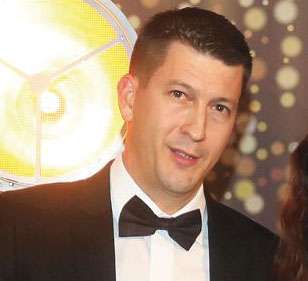
Jamie Thomson, Director of Thomson Properties
If there is one thing I have learned from growing up in rural Zimbabwe to starting a business in suburban Surrey, it is to control the controllables. You don’t have a say where you’re born, the family you’re born into or what happens to the people you love. There are so many things in life that are beyond our control, however, we do get to choose how we respond to them.

My father was killed in action just days before the end of the Rhodesian War when I was 10 months old. So it was just myself, Mum and Tammy my older sister, until Mum remarried Ed a few years later. Ed had also been a soldier in the war and he took Tammy and I on as his own children. It was his strength, faith and fearless approach to life that influenced me most growing up and I knew him as my father. The local Shona community called him ‘Kenge’, which means “awesome” or “great”, a hugely respectful term, especially for a white man and one I didn’t fully appreciate at the time.

Origins in Karoi
Our family’s farm was in Karoi, a farming area north of the capital, Harare and not too far from Lake Kariba. We raised cattle and grew tobacco, maize and mangoes and a typical day could range from driving tractors, herding on horseback or fighting veld fires. But it was motorbikes, horse riding, shooting and adrenaline-infused adventures on Lake Kariba that drove my passion for life.

Kariba is one of the largest man-made lakes in the world: a wild expanse of water, with stunning beauty and dramatic sunsets. Here we would go by boat to a deserted island inhabited only by elephants, antelope, hippos, crocodiles, baboons and one lone buffalo.

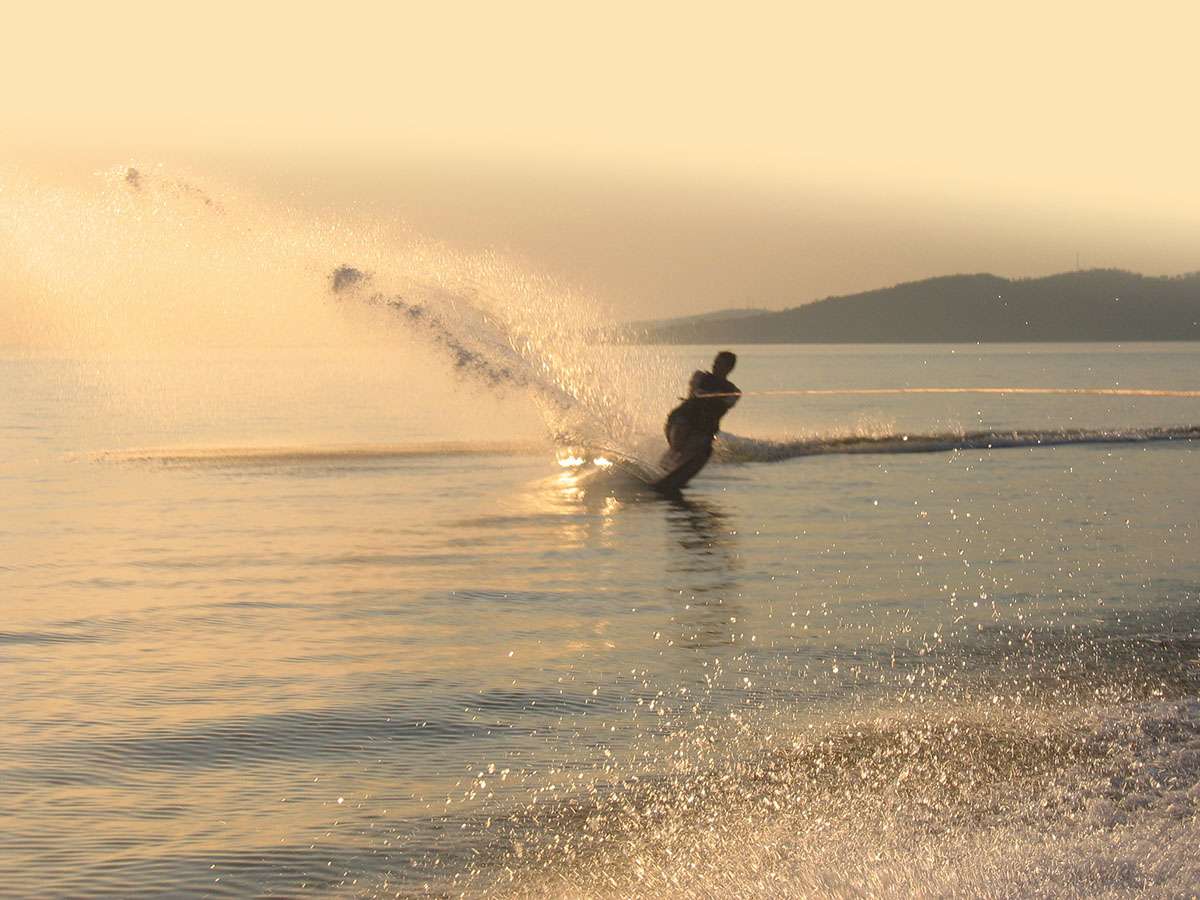
We took tents but would mostly sleep under the stars on the shores of the lake, cooking over an open campfire and bathing in the lake. Elephants would sometimes wander into our camp and help themselves to our food, and we spent our time waterskiing, rod-fishing and spearfishing. Our favourite time to spear fish was at night, using a sealed beam spotlight to look for fish below the surface whilst swimming, pulling the boat along behind us. Crocodiles were a constant threat and we became quite skilled at moving them on. Ed’s philosophy seemed to be that ‘danger’ was OK, as long as you were careful. I always felt perfectly safe spearfishing or dealing with crocodiles alongside this seemingly invincible giant of a man.

When I tell people here about my many experiences with crocodiles, they often look at me in disbelief. But it was not that uncommon for kids growing up in that part of the world to encounter such things. Dangerous animals, snakes, bushfires, tractors, guns and living off the land were simply part of my childhood, not a fictional adventure story.
Everything Changed
My childhood stopped in its tracks when I was 15. My sister Tammy was involved in a car accident whilst coming to collect me from boarding school. She had been my best friend and inseparable soul mate. At just 18 years old, she was gone.

I don’t really remember deciding to change; I just did. I lost interest in school, I stopped caring about much outside of our immediate family and for a time even disregarded fear itself. Looking back I see that I had subconsciously adopted a belief that nothing worse could happen to me. Life simply wasn’t that unkind.

If I had already lost a father and a sister then surely nothing worse could possibly happen. This perceived immunity gave me a strong feeling of invincibility which was of course pretty dangerous given the environment that I lived in. Living life on the edge continued but now without any fear. I can only attribute the fact that I’m still alive to my belief that I wasn’t walking alone.
Moving on, but only to return
At 18 it was time to move on. I packed a bag and booked a flight to the UK. My first job was in a bar in Weybridge and it was pretty full on. Shifts were often from 9am – 4.30pm, a short break and then 7.30pm to closing. The other staff became family and life seemed to stabilise for a while. I flew home regularly and after being couped up in the smoky bar, the first thing I’d do is climb onto a horse and gallop through open fields, taking in the fresh air, space, peace, sunshine and the freedom. On one of these visits, tragedy struck again. Ed, my seemingly invincible hero, was killed in a car accident.

I was 20. How could I ever step into the shoes of this legend of a man? There was a family to support, a farm to run, 65 employees to oversee and an estate to wind up. When I look back I am in awe of my mother and 2 younger siblings. It was like having the guts ripped out of our lives but somehow, with God’s help and much support from our incredible farming community, we kept going. We finished the farming season, we wound up the estate, built another house on the farm so that we could remain in ours whilst leasing out the farm. Building that house was my first taste of construction and I fell in love with it.
The gold game
With the farm sorted, I explored other opportunities in Zimbabwe. These included a successful car sales business and then buying a small share in a gold mine which I managed on behalf of the other shareholders. Mining and processing gold was a fascinating process and with 120 employees, I loved the challenge. Moving around with large amounts of cash or gold meant that we were often armed and created an environment that was often fuelled by adrenaline by day and vodka by night.

From a business point of view, I was riding the “crest of the wave” and that feeling of invincibility was intrinsic. However, as is always the case, the wave eventually crashed. Like most white farmers, our farm was seized during Mugabe’s land invasions of the early 2000s. These forced seizures of white-owned commercial farms were politically framed as redressing colonial-era land ownership imbalances. But in practice, it led to widespread violence, economic collapse, food shortages and the displacement of farming families who supported and sustained the local communities.

This affected my other businesses too and lead to record breaking hyperinflation. With everything slowly crumbling, that feeling of invincibility vanished. I sold what I could and headed back to England.
My life experience had little transferable value in the UK. I had zero qualifications and I hadn’t even bothered to pick up my O-Level certificate from school. With limited options, I returned to the bar in Weybridge and was grateful to be welcomed back. It was humbling to go from managing multiple businesses and hundreds of staff to pouring pints again, but looking back, it was the best thing for me.

In the Book of Ecclesiastes, it says, “In the day of prosperity be joyful, but in the day of adversity consider…” That is life, with its many twists, turns, lessons and victories, in a nutshell. You don’t get to choose what happens to and around you, only how you deal with those things. And often it’s the hard seasons, the ones you’d never wish for, that teach you the most.
Another business in the making
Discussing my lack of direction with someone at the bar one evening, they suggested I get a trade. Soon afterwards I saw a newspaper advert to train as a plumber. I never dreamt I’d be a plumber, but thought ‘Why not?’

I signed up and kept working at the bar around my training. The clientele at the bar became my first plumbing customers. It was a simple start – just me, door-to-door with my tool box. No business plan whatsoever, but I was happy to at least be moving forward.

I got married and moved to where my wife Shannon was teaching at Cranleigh School and started building a customer base there. At first, like most one-man bands, I did everything that I could do myself. But one day, when I had brought in a tiler to tile a bathroom I was working on, it dawned on me that there was a potential business model here. Getting tradesmen to do certain jobs that, in all honesty, they could do much better than I could. The poor reputation of trades people in the UK had also begun to frustrate me, so I decided to focus my efforts more on customer service. We started to grow, one tiler leading to another and soon we were a small team.

Loyalty and teamwork redefined
Comparison is an odd thing when the 2 halves of your life have been so extreme. If you’d asked me back in Zimbabwe what loyalty or teamwork meant, I would have pointed straight to Ed. To me he was the ultimate example of both. He had been in the Selous Scouts, an elite unit of the Rhodesian Army famous for its counterinsurgency and deep-infiltration operations. In the years following his death, I learned so much about him from his fellow soldiers.
One guy told me how Ed was overseeing one of his first parachute jumps. As they stood eye-to-eye at the plane’s open door, “Ed noticed I wasn’t wearing a helmet,” the guy told me. “Then instead of telling me off for misplacing this vital piece of kit, he removed his own helmet and put it on my head”. He went on to describe how he ended up colliding with a tree when he landed and that the helmet probably saved his life, protecting his head from a branch that he smashed into. That helmet, still with some of the branch firmly lodged in it, hung above the aircraft door for years afterwards as a reminder to all jumpers why helmets mattered. Ed had jumped without one himself that day.

I heard so many stories like that from men he served with, each one a quiet lesson in leadership. But Ed never spoke to me about his acts of bravery and heroism. That is what made his influence so impactful and why it taught me so much about leadership. He didn’t tell his family, friends or colleagues what loyalty, teamwork, resilience and courage looked like. He showed us.

Today within our company, our ideas of loyalty and team work are of course less dramatic, but the principle is the same. It is about who shows up when no one’s watching and who takes extra care because they believe in doing it the right way, not just the easy way.
F3 and new beginnings
Surprisingly, I’ve come to enjoy and embrace the quiet family life in England bringing up our 2 girls while running a business and looking after my small, loyal team of fitters. Most people who meet me would probably describe a quiet, unassuming, thoughtful person, but the desire for adventure still burns brightly inside.

A few years ago, I discovered a different way to reconnect with this part of my life.
A good friend of mine invited me to F3, a free, peer-led, outdoor fitness group focused on Fitness, Fellowship and Faith. When he said the workouts were outdoors at 5:30am all year round, come rain or snow, I just laughed. There was absolutely no way I would get involved. Then one day, I found myself standing in a dark car park in Guildford, half awake, surrounded by a handful of men about to start a workout. Halfway through, whilst “bear crawling” and gasping for breath, I thought ‘What on earth am I doing here?’ Yet for some reason, I did one more workout, then another and soon I was hooked. Not too long after I was doing their overnight ruck, carrying logs up St Martha’s hill and getting pushed to the limit by the visiting American cadre.

F3 arrived at exactly the right time in my life. I’d just given up alcohol, realising it was becoming a crutch for stress. But quitting it left a void, a space where all that pressure needed somewhere to go and F3 filled it.
The workouts made me physically stronger but the community made me whole. These men became brothers, leaders, examples. You can’t hide in F3, sooner or later, you’re leading. And leadership built there translates everywhere: marriage, parenting, business, life. The mental benefits have been staggering. When I skip F3, I feel it. Not physically but mentally. I’m clearer, calmer, stronger, better when I show up.

F3 doesn’t just teach leadership, it teaches servant leadership. The same kind modelled by the greatest leaders in history. The kind that lifts others before lifting yourself. In our own workout group we have tried to build on this in some way by creating a small charitable fund called Beyond F3. It’s nothing big; it’s simply a pot of money raised by men who want to directly help people in our own community with immediate needs. Fast, flexible, financial support with no bureaucracy, just service, which is how we feel it should be.
Lessons I hope to carry into the future
When I look ahead to the future, the advances in AI, the rumblings of war, our rapidly changing world and then consider what particular lessons I should take with me from my past, the first words that come to mind are resilience and courage. With life’s ever changing landscape, surely it’s going to be those who can adapt and rebound fastest who will survive as well as succeed.
I love Churchill’s famous words “Success is not final, failure is not fatal, it is the courage to continue that counts”.
My most inspiring real-life example of resilience has to be my mother. After being forced to give up a daughter for adoption, being widowed twice by the age of 46, losing another daughter, losing her home, losing her farm and her livelihood, she still stands and she still lives life to the full! Have there been times when she’s hit rock bottom? Of course! But, she keeps leaning into her incredible faith and bouncing back. My hope is that, one day, I too can demonstrate this same courage and resilience.