
by Joy Horn
Occasionally we hear old stories about Cranleigh that claim to be true but little known. What are we to make of them? One of these is a rather ghoulish tale that Margaret Roper, the daughter of Lord Chancellor Sir Thomas More, kept the severed head of her father at Baynards.
I don’t know when or where this story originated, but the Waverley District Official Guide (1975), says that Sir Thomas More ‘whose favourite daughter Margaret was married into the Roper family,… came to live at Baynards near Cranleigh’. It adds that Sir Thomas More ‘no doubt worshipped’ at the parish church of St Nicolas. Mrs Gwen Viney in her delightful Memories of Cranleigh (1992), improves on this. She writes: ‘Baynards was built by Sir Thomas More for his daughter Margaret Roper, and the story goes that after her father’s execution she brought his head to Baynards in a red painted chest – this I have seen.’

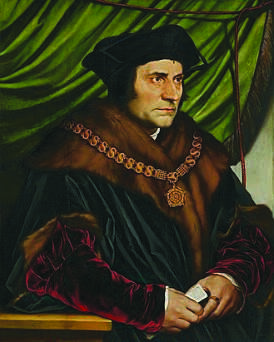
There are elements of both truth and error in this story. The picture shows Sir Thomas More, lord chancellor of England (1478-1535), of whom we have all heard, though we probably don’t remember much about him. In fact, Sir Thomas, who you will notice died in 1535, didn’t build Baynards and never gave it to his daughter. There was no mansion here until after 1587, though there may have been a hunting-lodge (the name ‘park’ tells us that this was an area enclosed for hunting).
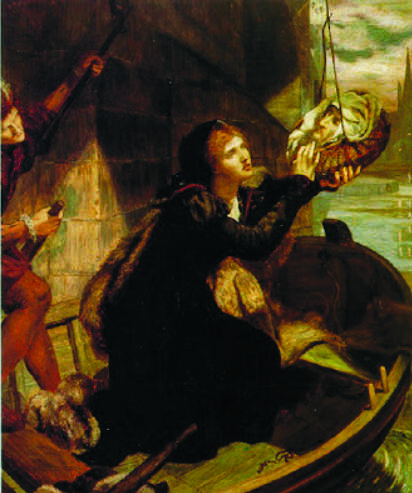
However, it is true that Sir Thomas More’s daughter Margaret More (1505-44) was very close to her father, and was, incidentally, a very learned lady. At the age of 16 she was married to William Roper, and they lived at Well Hall, Eltham, Kent. Sir Thomas More, the lord chancellor, fell foul of the king, Henry VIII, over the breach with Rome, and refused to endorse the Act of Supremacy – that the king was head of the church in England – in 1534. For this, he was imprisoned in the Tower of London. Margaret visited him there several times. Sir Thomas refused to change his mind and as a result was executed in 1535 for treason. His head was impaled on a spike, and was displayed on Tower Bridge for a month, as was customary for traitors.

Margaret bribed the man who was meant to throw the head into the Thames and rescued it. She preserved it with spices and kept it in a box. This is a Victorian imagining of the scene painted by Lucy Madox Brown.
If the story is true so far, presumably the head was with her at Well Hall, Eltham. Margaret died in 1544 and was buried in Chelsea parish church (the More family church), with the head, allegedly, in its box. William Roper never remarried, and when he died in 1578, Margaret’s body was exhumed, to be buried with him in the Roper family vault in St Dunstan’s church, Canterbury.

A fine monument was set up in 1932 over the Roper family vault, specifically mentioning that the head of Sir Thomas More was there. I don’t imagine that much in the way of tests was done on the head in 1932. In 1978, the vault was opened again, and a lead casket containing the fragmented remains of a skull was discovered built into the wall of the crypt, but this was still before DNA testing was possible. I’m not sure how watertight this story is, but it seems to make it impossible that Sir Thomas’s head could have been, in its red box, at Baynards in the twentieth century.
There is also a Thomas More window in St Dunstan’s, with scenes from his life, including his execution, presumably top right.
The story of Margaret Roper living at Baynards may have arisen because Sir Edward Bray (one of the Bray family of Shere), owned Baynards Park from 1558, and happens to have been married to Elizabeth Roper, daughter of William and Margaret Roper. Alternatively, it may have arisen through Sir Thomas More being confused with the More family of Loseley (now the More-Molineuxs). Sir George More of Loseley did build Baynards, though not until after 1587, when he married a rich wife and could afford it. There are strong similarities between the two buildings – or were, because Baynards was burnt down in 1979, when it was owned by helicopter entrepreneur Alan Bristow.
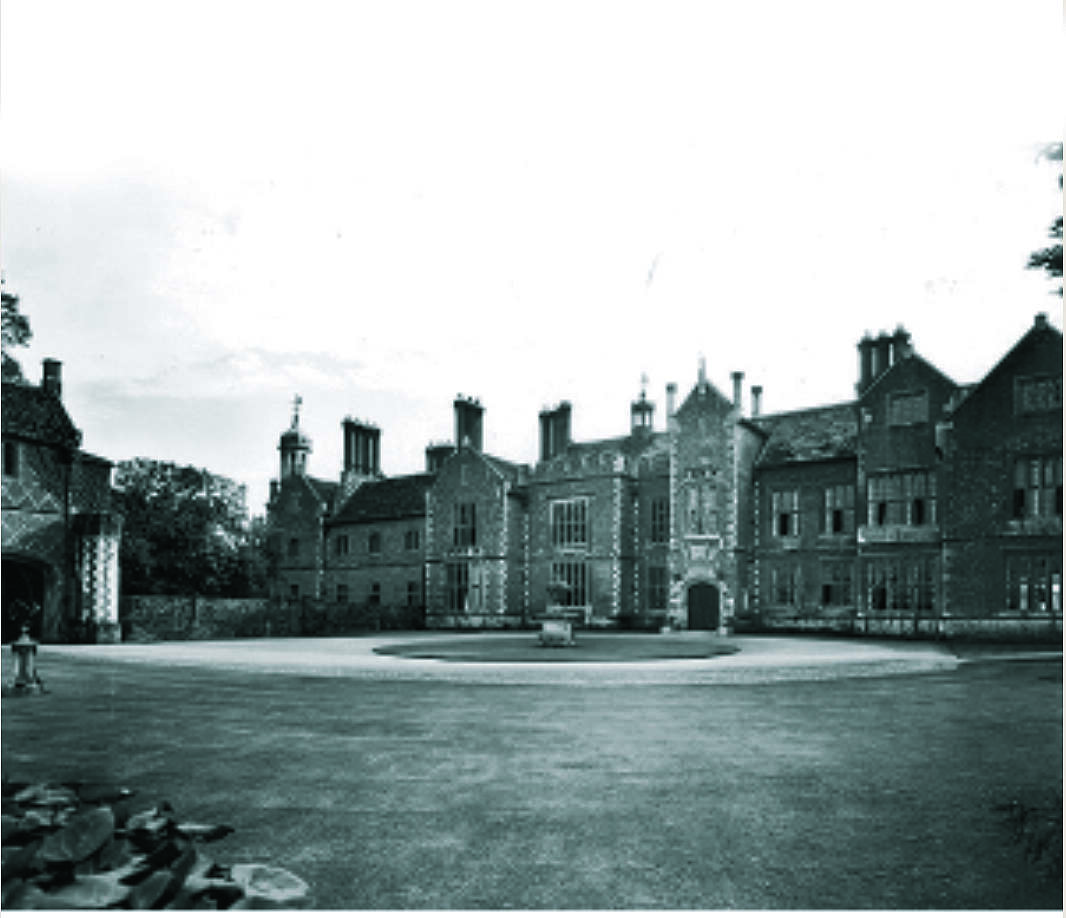
Sadly for this macabre story, there is no evidence that Margaret Roper ever lived at Baynards or that Sir Thomas More darkened the doors of St Nicolas parish church.
Where did the Waverley District Guide get this story? And what was the red box shown to Gwen Viney at Baynards, allegedly containing the head? Unfortunately, the story doesn’t stand up to investigation and so it counts as one of our Cranleigh myths.
The Cranleigh History Society meets on the second Thursday of each month at 8pm in the Band Room. The next meeting is on Thursday September 11th, when Judith Grant will speak on ‘The life and times of Queen Victoria’.