
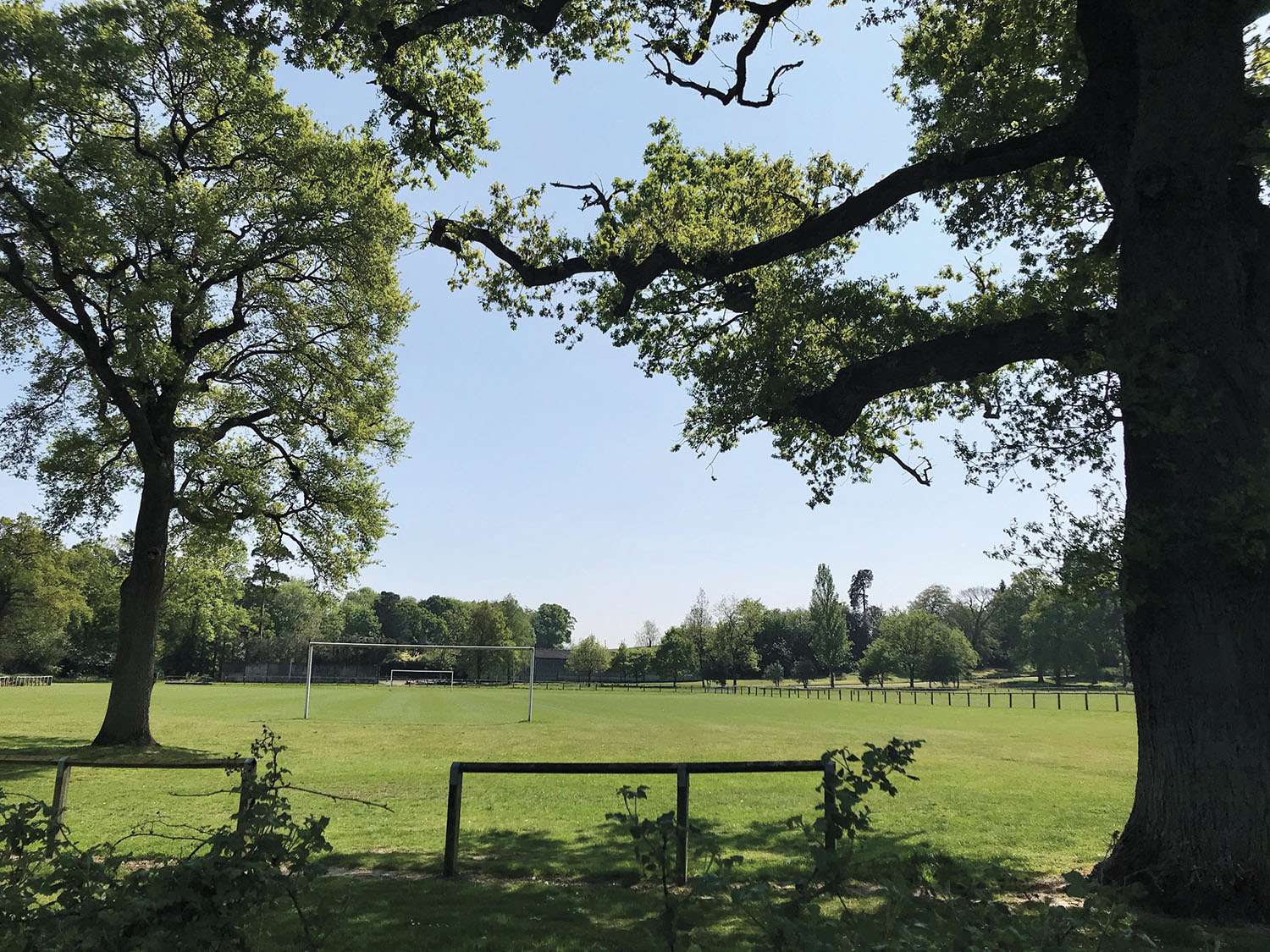
by Joy Horn // Main Photo: The lovely Bruce McKenzie Field on the old Knowle grounds
This is the first article in a short series on some of the varied people who have made a home in Cranleigh and a distinctive contribution to it.
Bruce McKenzie (born 1919) was a South African, who was educated at Hilton College, Natal, before joining the South African Air Force in 1939 and becoming a Second World War fighter pilot.

His plane was shot down over the Mediterranean, and he spent two days drifting in the water with half of his face hanging off before he was picked up. He later wore distinctive bushy sideburns to hide his injuries. He was awarded the Distinguished Service Order and the Distinguished Flying Cross.
Post-war, he emigrated to Kenya and farmed successfully in the Nakuru area, specialising in pedigree Friesian cows. He played a prominent part in public life. Nominated to the Legislative Council in 1957, he became a specially elected member in 1958, Minister of Agriculture in 1959 and Minister of Lands and Settlements in 1962. He was the only non-African ever to serve in independent Kenya’s Cabinet and as a Minister in a critical department, where he successfully oversaw the transfer of land from white settlers to Kenyans, using British government money for compensation, and built up the Kenyan tea industry. He was a close friend of the first Kenyan president, Jomo Kenyatta, who relied heavily on him (especially for his British government contacts). Gradually, it has emerged that he was also involved in the secret services of South Africa, Britain and Israel (Mossad).

Kenya had become independent in 1963, but rifts were apparent within a few years, particularly between the dominant Kikuyu tribe and other, smaller tribes. Several dissident Kenyans were assassinated (such as Tom Mboya and Pio Pinto), and in 1969 McKenzie sensed that being in the government was becoming too dangerous for him. He resigned from the Cabinet, claiming ill-health.
It was at this point, 1970, that he bought Knowle. His second wife, Christina, was also keen to leave Kenya, with their two sons. Their precise reasons for choosing Knowle are unknown. Bruce continued to spend much time in Kenya, where he had extensive business interests, as director of up to twenty major concerns and owning at least three homes. He also had a London flat, near to friends such as the writer on espionage, Chapman Pincher, and Sir Maurice Oldfield, head of MI6, the British foreign intelligence service.

In 1976 McKenzie was involved in the famous Entebbe Raid. In June, an Air France airplane was hijacked by German and Palestinian terrorists. It was flown with 106 Israeli passengers as hostages to Entebbe airport, Uganda, at the invitation of Idi Amin, president of Uganda. Israel conducted a daring rescue on July 4th 1976, flying 100 commandos 2,500 miles to Entebbe, where it destroyed the Ugandan airplanes surrounding the hostage plane and then flew the hostages back to Israel. Lt.-Col. Yonaton Netanyahu (aged 30), led the operation and was the only rescuer to be killed. He was the elder brother of the present prime minister of Israel.
McKenzie played a vital part in this rescue by enabling a Mossad agent to take photographs of the installations at Entebbe and of the parked Ugandan fighter jets which were comprehensively destroyed in the Israeli raid. This amounted to one quarter of the entire Ugandan airforce. He also secured permission from President Kenyatta of Kenya for the Israeli planes to re-fuel in Kenya for the return flight to Israel. Later, Meir Amit, the chief director of Mossad, had a forest planted in Israel commemorating McKenzie.

In May 1978 McKenzie, travelling in his own light aircraft, went on a business trip to Uganda where he met Idi Amin. At the conclusion of the meeting McKenzie decided to leave for Nairobi. After he and his companions had boarded the plane, a carved lion’s head (sometimes said to be an antelope’s head) was given to McKenzie as a parting gift from President Amin. A bomb had been planted in it, and it went off over the Ngong Hills, Kenya, killing all four men on board. A friend, Fitz de Souza, went to survey the site of the crash, and got ‘a terrible shock … seeing among the wreckage what I felt sure were the metal plates of Bruce’s jaw, rebuilt after his wartime injuries’.
Debate continues as to whether McKenzie or another passenger was the intended victim, and whether McKenzie acted out of character in visiting Idi Amin and in accepting a gift from him.
Chapman Pincher maintained that Harold Wilson (prime minister in the 1960s and 1970s) thought so highly of McKenzie that he wrote an obituary of him for The Times. However, the paper declined to print it, as it was so critical of Idi Amin.

Christina McKenzie and her two sons were left living at Knowle. Around 1985 the house and the grounds were separated. The house became Knowle Park Nursing Home, and the land was bought by Nick Vrijland, who had been running a large lettuce farm in Alfold Road, near to Knowle. As readers will know, he and his wife Rowena generously created and endowed the beautiful Knowle Park Country Park in a large part of this (opened 2023).
In addition, Nick Vrijland exchanged part of the land with the Cranleigh Parish Council for a small area at Snoxhall Fields. The area on the old Knowle estate was named the Bruce McKenzie Field at his request, to be used for additional football pitches. He gave the area at Snoxhall Fields to be the site of a new Cranleigh Hospital, which never materialised.
This article owes much to the help of Ashi Chand who supplied many books and other material which helped understand this ‘enigmatic man’. Rowena Vrijland kindly gave time to describe her and her husband’s friendship with him and Christina. Nigel Balchin scoured the internet for further details. Grateful thanks to each of them. There is undoubtedly much more to be discovered about McKenzie.
The Cranleigh History Society meets on the second Thursday of each month at 8pm in the Band Room. The next meeting is on Thursday January 8th, when after a brief AGM at 7.30,pm Michael Miller will speak on ‘The Rev. Robert Barbor Wolfe’.