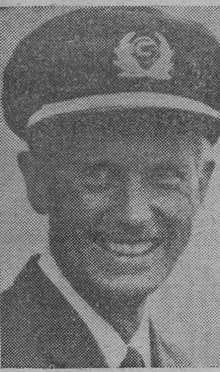


by Joy Horn // Main Photo: Charlie Parker, complex cricketing genius (courtesy of Martin Williamson)
If you ask Google which cricket players have taken the most first-class wickets ever, you may be surprised that it was not Stuart Broad or Jimmy Anderson, not Ian Botham, not Tony Lock or Jim Laker nor Alec Bedser. The heyday of County Cricket was in the 1920s and 1930s, and since then an increasing number of shorter-form matches have been played. So the top three first-class wicket-takers were Wilfred Rhodes, Tich Freeman and Charlie Parker.
Well done to anyone who recalls Charlie Parker! He is no longer well known. Yet he played for Gloucestershire as a left-arm off-spinner for an incredible 32 years (1903-35), and had taken 3,278 wickets by the time he retired aged 52. Today it is rare for anyone to play first-class cricket beyond 40, and most cricketers retire well before that age.

Before the First World War, Parker was a competent but not exceptional bowler, but in 1919, when he was 36, he cut his speed and relied more on his spin. Thereafter his achievements were remarkable. He took more than 100 wickets every season and more than 200 in five. He took 5 wickets in an innings 227 times and 10 in an innings 91 times. He took 6 hat-tricks, twice against Yorkshire, and once against Middlesex in both innings. In 1921, on 7 occasions he took 15 or more wickets in a match. He claimed that he had created a world record in 1929, when ‘I bowled through the whole of the Worcestershire innings and only one run was scored off me’ (although unfortunately the records vary slightly from his account). In 1930, at Cheltenham, he took 8 Surrey wickets before lunch. The same year he dismissed Don Bradman 3 times during the Australian tour: in 1934, during the next Australian visit, Bradman declined to play in the match against Gloucestershire.
And yet, Parker played only once for England! It was in the drawn test of 1921, when in the only Australian innings his figures were 28 overs, 16 maidens, 2 for 32.

Parker was a farm worker’s son, born in Prestbury, Glos. He won a scholarship to Cheltenham Grammar School but his formal education was brief and unimpressive. However, he was an intelligent man who read widely and voraciously. He resented the attitude in the cricketing world of amateurs (unpaid gentlemen members of the side) towards paid professionals, who were treated as second-class team-members. Parker was articulate in expressing this injustice in colourful language. He appeared to have a chip on his shoulder, but had plenty of justification for his attitude, although this often landed him in trouble with the authorities.

Parker himself attributed the fact that he only played once for England to the animosity of Pelham Warner, the captain of England and chairman of selectors, and the embodiment of the cricketing establishment. In 1926 Parker was summoned to Leeds for the Test team, and then left out. It was ridiculous and unjust treatment. An incident is told of Charlie Parker at a Gloucestershire Cricket Club dinner at the Grand Central Hotel in Bristol, when the visiting speaker was Pelham Warner himself. An obsequious lift attendant was trying to create room on a crowded lift for the distinguished visitor, saying, ‘Make way for Mr Pelham Warner. We must have room for him in the lift. Make way, please.’ Parker grasped Warner by his lapels, declaring, ‘I’ll never in my life make way for him. He’s never once had a good word to say for me. This so-and-so has blocked my Test career … Make way for him! Mr – Warner will go to bed when I’ve finished with him.’ A fellow team member calmed him with ‘Come on Charlie. It isn’t worth it.’ Parker relaxed his hold and the famous guest scurried up the stairs to his room. It should be noted that Parker was much loved by his fellow pros.

After his playing career, Parker served as Gloucestershire coach, and a first-class cricket umpire. But then comes the big surprise. In 1943, Parker accepted an offer from Cranleigh School to become school cricket coach. How did someone with his strong left-wing views and readiness to speak his mind cope with life in an English public school?
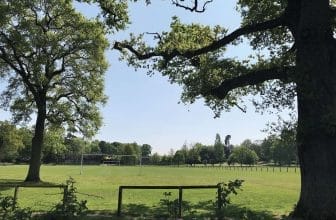
He moved with some of his adult children to a maisonette in Wyphurst Road, from where he could walk across the fields to the school. His impact as coach was immediate. Looking back on his life in 1959, The Cranleighan reported, ‘Charlie expected his pupils to apply themselves with all the keenness and zest which he himself showed. He had no use for the dilettante. His approach to the game was as direct and forceful as his character.’

The boys called him ‘Parlie Charker’, but never to his face. One boy described him at 72 years old: ‘lean, weather-beaten, six foot tall, dressed in an old suit and his trilby hat’, he would stand behind the cricket net offering sharp critical comment. One day, frustrated by the inability of the bowlers to bowl an accurate line and length, Charlie finally came into the net. From his pocket he took a white linen handkerchief and carefully laid it out on the ground on a good length. Nothing much improved. Ultimately, Charlie was challenged to show us how to do it. Brusquely he removed his suit jacket to reveal old braces and off three paces his classical left-arm action hit the handkerchief five times out of six. His first loosener ball missed by about three inches.’

After Parker’s retirement, this boy would visit Parker at home on Sunday afternoons, armed with some bottles of his favourite stout and cigarettes, to hear his cricketing stories. So mesmerised was the boy, that his house master had to telephone to summon him back for Sunday chapel!

(Grateful thanks to Angus Henderson, former president of Cranleigh Cricket Club, who introduced me to the principal biography of Parker, David Foot’s Cricket’s Unholy Trinity (1985), and to Martin Williamson, chairman of the Old Cranleighan Society, for his generosity in supplying information on the years 1943-54, when Parker was cricket coach at Cranleigh School.)
The Cranleigh History Society meets on the second Thursday of each month at 8pm in the Band Room. The next meeting is on Thursday February 12th, when Moira MacQuaide will speak on ‘William Heath Robinson’.