
by Miki Marks
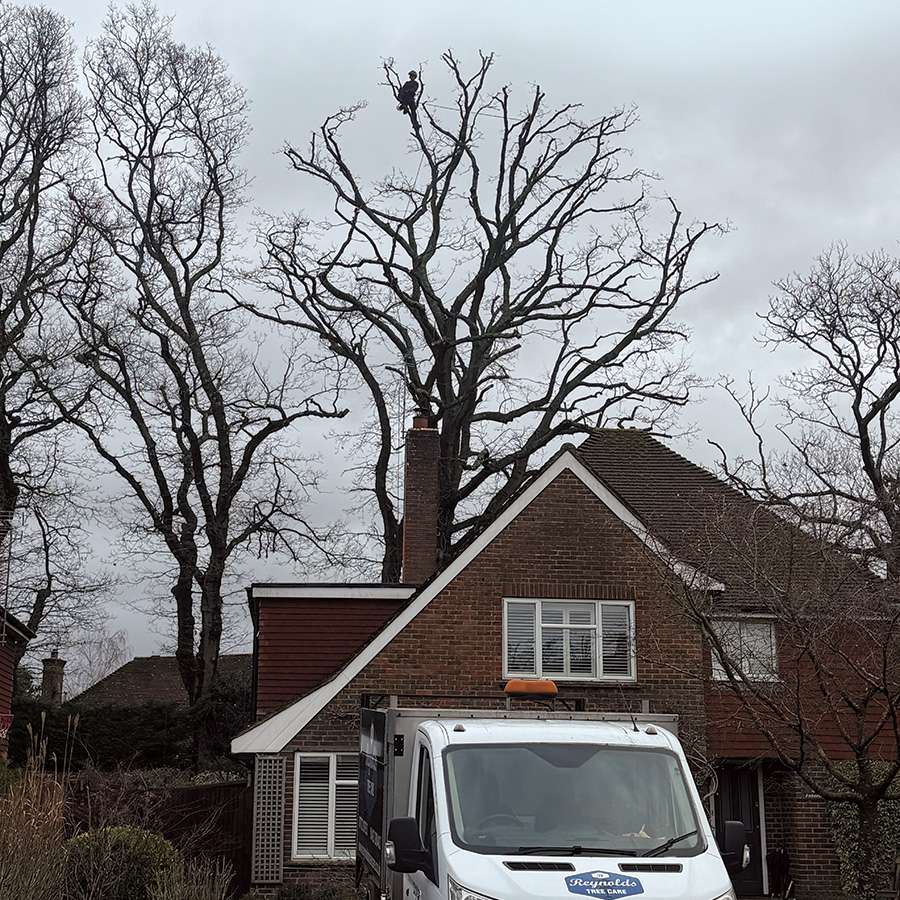
Hearing a chain saw whine is enough to raise my blood pressure as I wonder which mature tree is being felled next. We have lost 3 around here since the beginning of the year. So it was wonderful to see that the tree surgeons on the oaks close by were shaping and trimming the trees, not cutting them down. I not only admired their skill but the courage and acrobatics! See the photo above.
More good tree news – Waverley have planted some trees along the top of Cranleigh Common, which is usually referred to as the ‘bonfire’ site. I spoke to the head arboriculturist, Jack Adams and he told me that the species of maple were chosen to mirror the established maples on the main Common. These include the variety Deborah – because of their exceptional resilience to urban pollution, reflected heat and drought tolerance. As a bonus they also have renewed red growth in the summer and a dazzling display of autumn colour.

Contrast this with the dismal sight of the roadside woodland along the Horsham Road, just out of Cranleigh. Not maintenance, but slash and trash. It reminds me of the paintings of Paul Nash of the devastated WW1 battlefields in northern Europe. Was someone actually paid to do this?
The weather is warming and the air is full of scent. This is a time to activate that often neglected sense, one that usually occupies a peripheral position. Recent research has shown that scent is so evocative that it can transport us to a time and a place like no other sense. Neuroscience suggest that smell and emotions are stored together as one memory. Molecules from odours we inhale travel up through the nose, where they are detected by specialist cells lining the nasal cavity. From there the nerves carry this information to the olfactory bulb at the base of the brain which processes and deciphers the smells. At the same time, this information is also sent to the limbic system which is part of the brain responsible for emotion and memory. I find it interesting to consider what evolutionary benefit such a linkage could confer. I think it might partly be to reinforce in early humans a sense of belonging, as chances of survival are stronger for groups.

In 2021 France, described as a ‘rich repository of pongs’ passed the Sensory Heritage Law. The idea is that there is an olfactory heritage which needs recognising such as the unique and evocative smell of baguettes baking, coffee brewing and Gauloises? Japan’s Ministry of the Environment published a list at the same time which includes cherry blossom and sea fogs.

I was recently given an empty wasps’ nest. It was slightly damaged which meant that I could see the intricate internal construction. It is a beautiful object – now a silvery grey colour and easily qualifies as a Wild Wonder. The nest is made of chewed wood pulp from trees and wooden fences. There is an outer covering and inside there are hexagonal cells. At first there are only 20 cells which represent how many larvae the queen can feed. The larvae hang upside down and when fully fed, will spin silken cocoons to close the cells off.

These hatch into worker wasps, which will then enlarge to form a comb that hangs from the original section by a paper stalk. In the summer a nest contains wasps at all stages of development; eggs, young larvae, fully grown larvae, pupae and cells from which the wasps have matured and vacated. It takes about 30 days to develop from egg to mature adult and a nest might contain up to 10,000 or more cells and be tended by 2 or 3,000 workers. These wasps are known as social wasps – as opposed to the ‘solitary’ wasps. Social wasps are more common some years than others and this seems to depend, unsurprisingly, on the weather. A cold, wet spring is unfavourable to the formation of nests – but so also is a warm early spring, and then a sudden cold snap as there will be fewer insects for the wasps to feed to the larvae. Wasps are considered a pest, especially at picnics but they play an important part in insect control and pollination in the cycle of life. I kept the nest in my conservatory, and in the relative warmth two ladybirds crawled out – presumably they had been hibernating in the nest. And then I spotted a spider in there too. A nice example of a natural ‘bug hotel’.
By the time you read this, I hope that the Parish Council have met with the volunteers of the Beryl Harvey site and that there is a conservation plan agreed. I will let you know.