
by Miki Marks
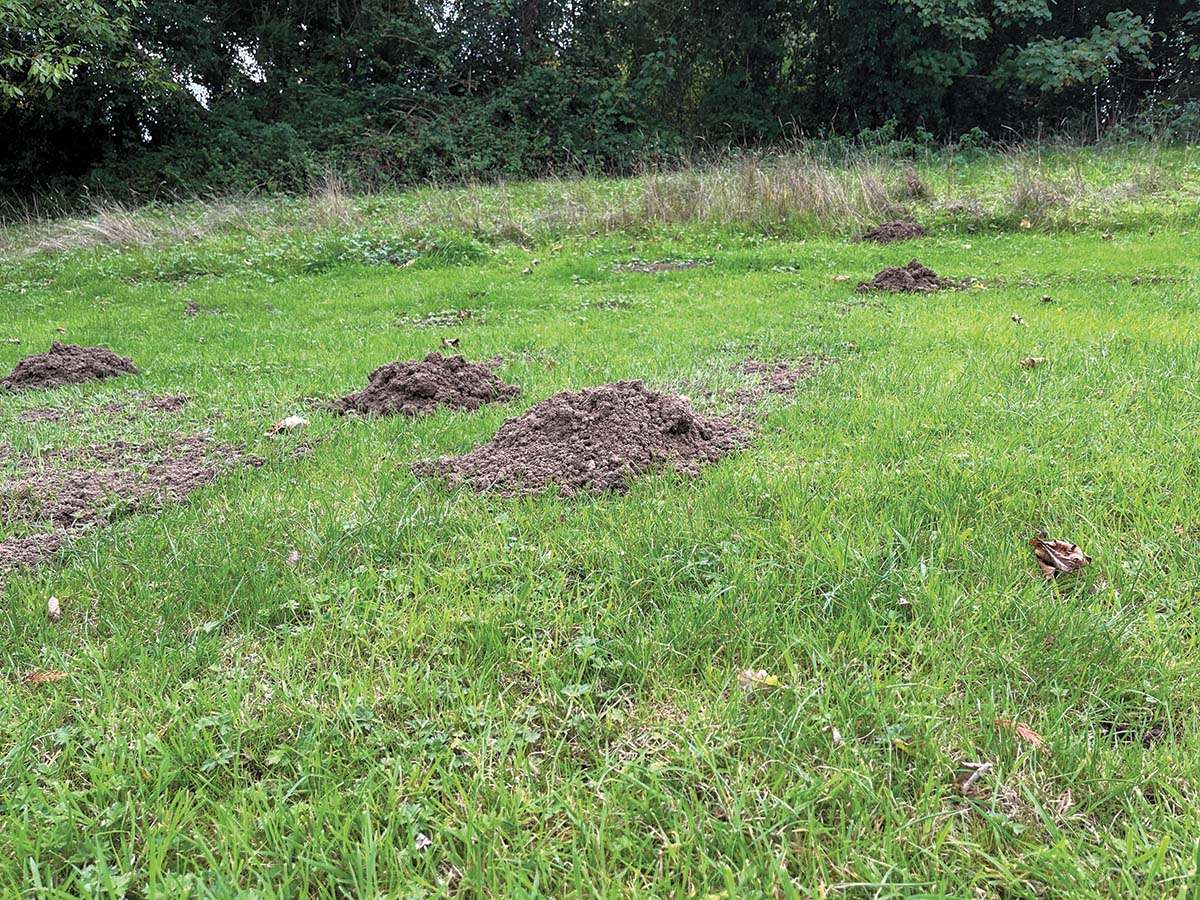
Just after the rains turned the lawns back to a nice lush green, the mole hills appeared. At first two, then a couple of days later four and by the end of the week there were sixteen on the lawn at Knowle Park Care Home. This is unusual as the main mole activity is usually late winter and early spring – although there can be an increase after a dry spell – which I think is what is happening here. That hints at the most incredible underground activity. Moles are seldom seen above ground – despite being active day and night – the main evidence we have of their existence is the little loose mounds of earth that form on the surface. Their usual diet consists of earthworms which fall into the mole tunnels. The moles preferred habitat is actually deciduous woodland and there they build large mounds called ‘fortresses’ which are usually hidden in dense undergrowth. A mole can dig up to 60 feet of tunnel in a single day – which is amazing for a creature measuring a mere 7 inches from nose to tail. Moles are not blind as is often thought, but have very small eyes protected by dense fur. They breed in the spring – usually giving birth to 3-5 pups, born naked and blind. They develop their velvety fur in 14 days and their eyes open about a week later. By 9 weeks after birth they are fully adult and establish branch tunnels of their own. Their life span, is on average 5 years.

Moles are shy, retiring creatures and seldom seen. However, a mole was credited with killing William III, King of England aka William of Orange. The horse tripped on a mole hole and threw the King, who broke a collar bone and died shortly afterwards from complications. Jacobites for years raised their glasses to toast ‘the little gentleman in black velvet’.
Moles have few enemies except for humans and their obsession with lawns – particularly sports grounds and golf clubs. When I first moved to Norfolk and had a very large garden, a neighbour, trying to be helpful, gave me the phone number of their ‘moler’. I did not contact him and hope that mole killing as a job no longer exists. However, a quick look on the internet shows me though that poison and ‘lethal’ mole traps are still available.

Not only are trees essential for our wellbeing, but they are beautiful and have inspired much poetry and art. Large mature trees can become reminders of historical events or symbols of longevity against the odds. The oak is generally accepted as the symbolic tree of England.

The Lebanese flag features a large Cedar of Lebanon – a tree known all over the world for its majestic stature and featuring in the Old Testament. The design of the flag was chosen at the fall of the Ottoman Empire. For the Lebanese the tree stands as symbol of enduring hope in a small country with a long history of war and invasion.
In Cranleigh we have a wonderful Cedar of Lebanon in St Nicholas churchyard. It is worrying that recently there has been discussion about the risks that tree presents to visitors and the church building. The tree has shed large branches in the past and it is not immediately obvious what the solution could be. It was probably planted in around 1848 and so it is in its mature state – although cedars can live to be much older. I was told that our St. Nic’s cedar has grown bigger and faster than it would have done in its country of origin, due to our wetter climate – and probably richer soil. That usually means that the tree is not as sturdy as it would be in the Lebanon.

It was very heartening to be contacted by Ian Thorburn, of Jewsons in Cranleigh. There is a strip of land bordering the main road and they wanted to make it more wildlife friendly. Bird and bat boxes have now gone up on the two mature maples on the site and there are plans to introduce more insect friendly plants, like shrubs and bushes and establish a small wild flower area. Hundreds of bluebells are being planted and it should look lovely in the spring. Do keep an eye out as you drive by.

I love writing my monthly articles for the Cranleigh Magazine. 61 so far! I have learnt a great deal in the course of my research, and made some very good friends. I try to concentrate on the ‘wild wonders’ round us – and that is why I love The Cranleigh Magazine – it is for local people, full of interest and celebrates the wonderful area we are lucky enough to live in. So Happy 10th Anniversary to Paul Higgins and his team.