
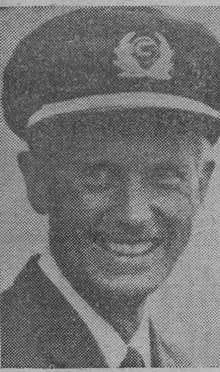
by Joy Horn // Main Photo: Peter Hogg, pictured in the Daily Express
Our story begins in August 1974, when Court Line, the British holiday charter airline went into liquidation. Peter Hogg had been working as a pilot for the company, flying one of their two TriStars. Court Line had pioneered ‘cheap and cheerful’ flights to Spain and elsewhere, based at Luton Airport. Their no-frills flights had made foreign holidays a reality for a new and large segment of the population. Peter had married Margaret at Caxton Hall registry office, London, on 15th November 1963. She was then a 24-year-old air hostess.
Their first home had been in Norton Way North, Letchworth. Neighbours described them as ‘pleasant, colourful characters’, who gave lively parties. One neighbour said, ‘Margaret was a bit of a girl. She used to sunbathe topless in her garden.’ Another said, ‘She was a typical air hostess, very good looking with long legs.’ Another said, ‘I always found her attractive and vivacious. I liked her husband as well. He was always very pleasant and friendly. She was an attractive brunette and used to work in a dentist’s surgery.’
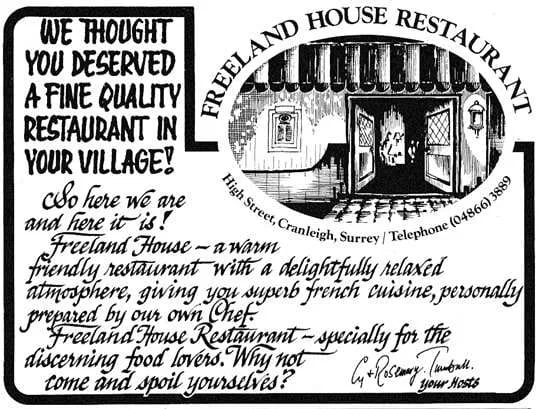
When Court Line collapsed, Peter Hogg found a new job at Gatwick Airport, where he worked on the Air Europe Boeing 757 fleet. The Hoggs, with their 2 sons, moved to Cranleigh, to a detached house in Mead Road. They bought a restaurant in the High Street called Freeland House, now Tay Tar Thai.
Margaret managed the restaurant, which specialised in classic English dishes. Florist Ann Bradley of Oliver House said, ‘Mrs Hogg dressed expensively and often came to my shop to buy flowers for her restaurant. She would show me the clothes she had bought.’ Her husband, Max Bradley, said, ‘She was a very pretty woman, vivacious and friendly. I would have guessed she had been a model at some time.’ One of the kitchen staff at Freeland House said, ‘She and her husband seemed to get on all right. She had an au pair to help her look after the children.’

However, on 1st January 1976, Mrs Margaret Hogg, 37, was reported as missing. Staff at Freeland House told the Daily Express that they last saw her after lunch on that day, when she said goodbye in a perfectly normal way as they were clearing up. They, and neighbours in Mead Road, believed that the marriage had broken down and that she had walked out on her husband. This was apparently what was believed by the sons, described by the neighbours as ‘lovely’ boys, who were then about 10 and 7. After a year, Peter Hogg sold the restaurant, which then seems to have changed to offering French cuisine.
Eight years passed and Cranleigh people had largely forgotten about Margaret Hogg’s disappearance. Then in February 1984, police frogmen in the Lake District National Park, searching for a female French student who had disappeared in the area the previous summer, fished a woman’s body out of Wast Water (the deepest lake in England). The body was trussed and wrapped in plastic sheeting, according to the Cranleigh Times, or ‘bound in carpet and plastic sheeting and weighted with a kerbstone’, as the Daily Express described it. It was found on a ledge 14 metres or 46 feet down, only a short distance from much deeper parts of the lake. The story was a gift to the national press, who dubbed it ‘the Lady in the Lake case’. When it was revealed that the woman’s body had a ring on her finger, inscribed ‘Margaret 15.11.63 Peter’, a Cranleigh resident phoned the police, suggesting the identification, which was officially made soon after.
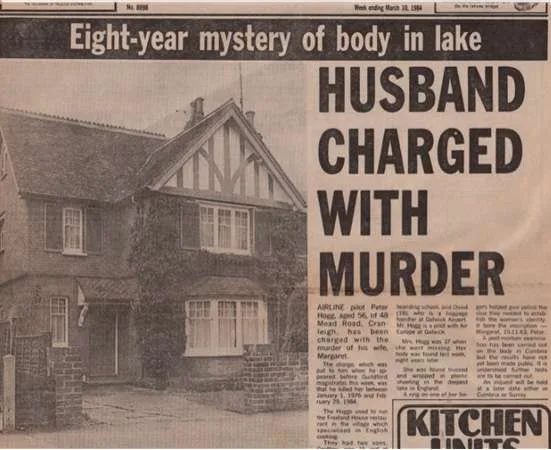
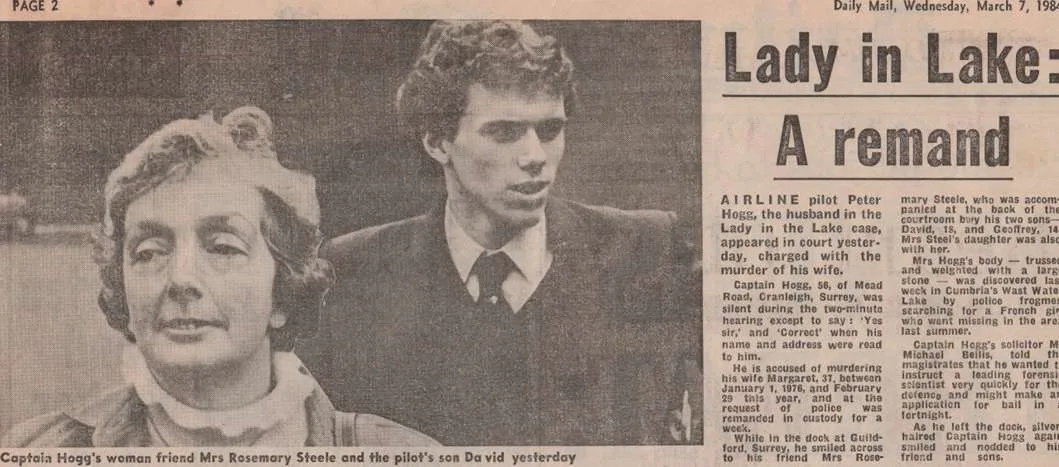
On 6th March Peter Hogg, 56, was charged in Guildford magistrates’ court with his wife’s murder some time between 1st January and 29th February 1976 and was remanded in custody for 14 days. Mr Michael Bellis, defending, said Mr Hogg would be briefing ‘top forensic scientists to defend the charge’. Home Office pathologist Dr Cyril Woodcock of Manchester University, would appear for the prosecution. The trial was expected to last at least a fortnight, with defence costs likely to run into many thousands of pounds.
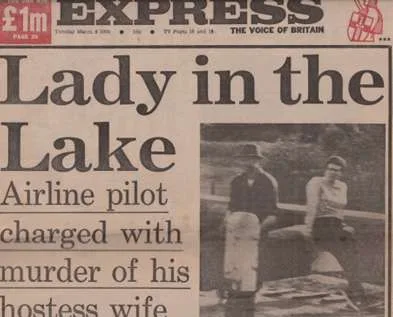
It transpired that Peter had employed Mrs Rosemary Steele, 48, as housekeeper since 1982, and that she was now his girlfriend. The Daily Express quoted neighbours as saying that she gave Peter ‘the steady, stable relationship he always wanted. … Don’t make him out to be some kind of lady’s man. All he ever wanted was a good, steady woman and a solid family life’.
After initially denying the murder, Peter Hogg later made a full confession. Margaret had had a 3-year affair with a banker called Graham Ryan and often flaunted it before Peter. At length he snapped and after a row, he strangled her. He drove overnight to the Lake District and put her body in the lake.
So there was no long trial after all. Because of the intense provocation, Peter Hogg was convicted on the lighter charge of manslaughter and was sentenced to 4 years in prison.
It was a sad episode in Cranleigh’s history, especially for the 2 young boys.
(This article is based on newspapers kindly loaned by Brian Cheesman, principally the Cranleigh Times, a newspaper of the day, 10th March 1984; Daily Express; 6th March and Daily Mail, 6th and 7th March.)
The Cranleigh History Society meets on the second Thursday of each month at 8pm in the Band Room. The next meeting is on 9th April, when Andy Nairn will speak on ‘When History meets Story’.