
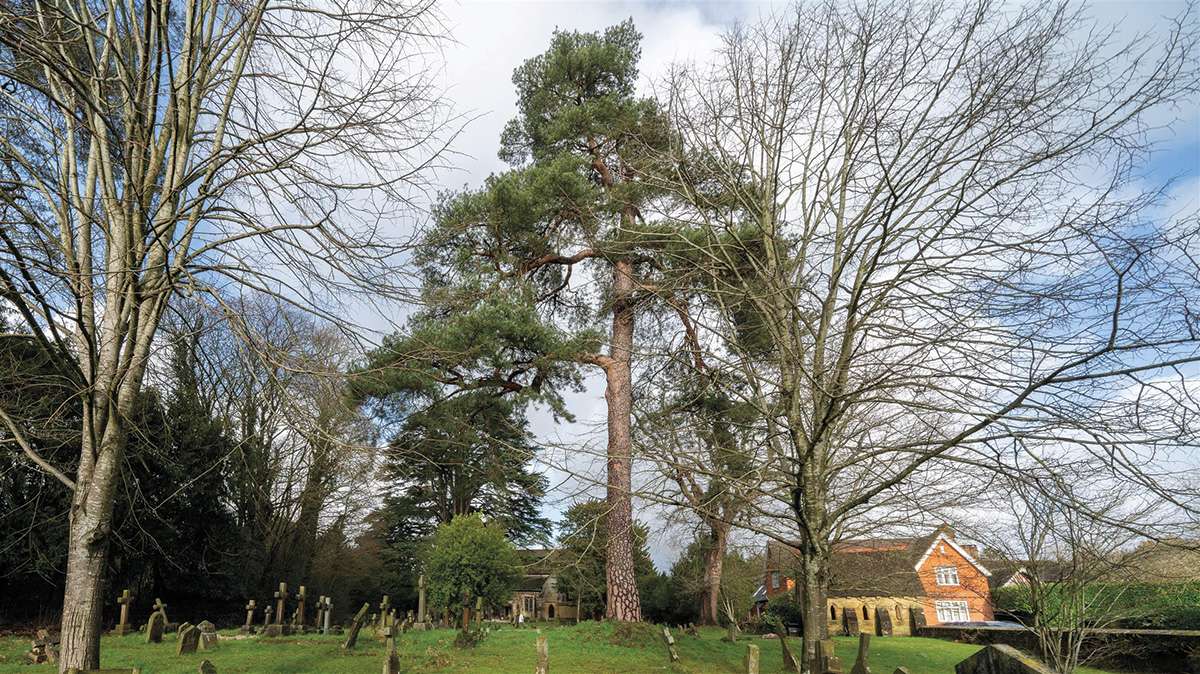
by Miki Marks // Main Photo: A Scots Pine in St Nic’s churchyard in Cranleigh
Last year was the driest spring in 132 years and the hottest summer since records began. It is interesting to be able to compare the seasons with Gilbert White’s Selborne diaries of 1781. In March, he notes blossom on the trees, insects in the house and snakes in the compost. He also noticed what the poet Seamus Heaney called “the warm thick slobber of frogspawn, growing like clotted water.” White was not fond of frogs for some reason, and found their croaking too loud. He believed that when the tadpoles grew lungs they had to leave the water or they drowned. He wrongly believed that when this happened, the tail of the tadpole was useless and dropped off. We now know that the tail is absorbed into the body. A good example of nature recycling.

I have been most interested in a recent article about the discovery of fossils of a life form which doesn’t fit in with any of our known categories – not plant, animal or fungus, and appears to be previously unknown and mysterious. It apparently grew to 26ft tall– and at first was thought to be an old tree trunk. But it had no canopy and it had no roots and how it lived has yet to be understood. The genus has been named prototaxites – and the latest fossils, believed to be 407 million years old, have been found in Scotland. The genus became extinct around 370 million years ago and one wonders why. Probably a widespread change in the environment it was adapted to live in and it became unviable. The rule in nature is ‘adapt or die’ and sometimes the change is too rapid. If this interests you, there is some remarkable information on Wikipedia and some imaginary illustrations of what this weird life form might have looked like.
Climate change due to global warming is happening rapidly and who knows who will be the winners and who will be the losers. Scots pines, the only pine native to the UK and Scotland’s national tree, are showing signs of stress due to heat waves and lack of rain. This evergreen conifer can grow up to 120 ft tall and live for 700 years. There is a nice example in the front of St Nicolas’ churchyard, by the Arts Centre. See the photograph (left) by Mark Matthews. The loss of this beautiful tree is more than just aesthetic; it can have a serious impact on the ecosystem as it has been calculated that the conifer supports about 1,600 species of insects and mammals.

Gilbert White also mentions in his March diary entry that the elms trees had started to ‘blow’ which is his word for blossom. These trees were part of our landscape and they grew to a magnificent maturity. Who would have thought that within living memory they have almost been wiped out? In the late 1960s and early 1970s there were 2 major outbreaks of Dutch Elm Disease which arrived on these shores in imported timber, spreading rapidly from the Channel to Scotland. Within 10 years, 90% of our elms had been decimated. Whether there are any saplings which will ever grow to large trees, we have yet to see. It does not seem likely as when the young tree gets to about 12 years old, they succumb to the disease. I remember watching as tree after tree was felled. I particularly mourned the magnificent avenue of historic elms from Hampton Court to Kingston. We now have Ash Dieback. We cannot take any of our native trees for granted and it is to be hoped that the Scots Pine manages to hang on.
Trees are essential to our well-being, which is why I am dismayed when I see a perfectly healthy tree cut down because someone judges it to be ‘in their way’.

Spring is famously the time when all of nature is stirring into life. A friend was most surprised to cut open a tomato and find what looked at first sight like a whole lot of maggots. In fact, the seeds inside the tomato had started to sprout. We had never ‘seen the like’ as they say in Norfolk and did some research. Apparently this is not some alien growth from outer space, but a failure in a hormone which inhibits seeds developing prematurely. This phenomenon is called vivipary and sometimes the impatiently sprouting seeds can even break through the skin of the fruit. It can happen when the tomato has been stored for too long or is overripe. It can also occur in strawberries, peppers, avocados and some citrus fruit. As the ‘mother’ fruit breaks down, the seedlings take advantage. Wonderful nature!
There’s gsood news about our conservation site at Beryl Harvey. We are working with the Parish Council to re-establish the volunteer group. Thank you to those of you who have already volunteered and I hope to give you more details next month.