
by Miki Marks
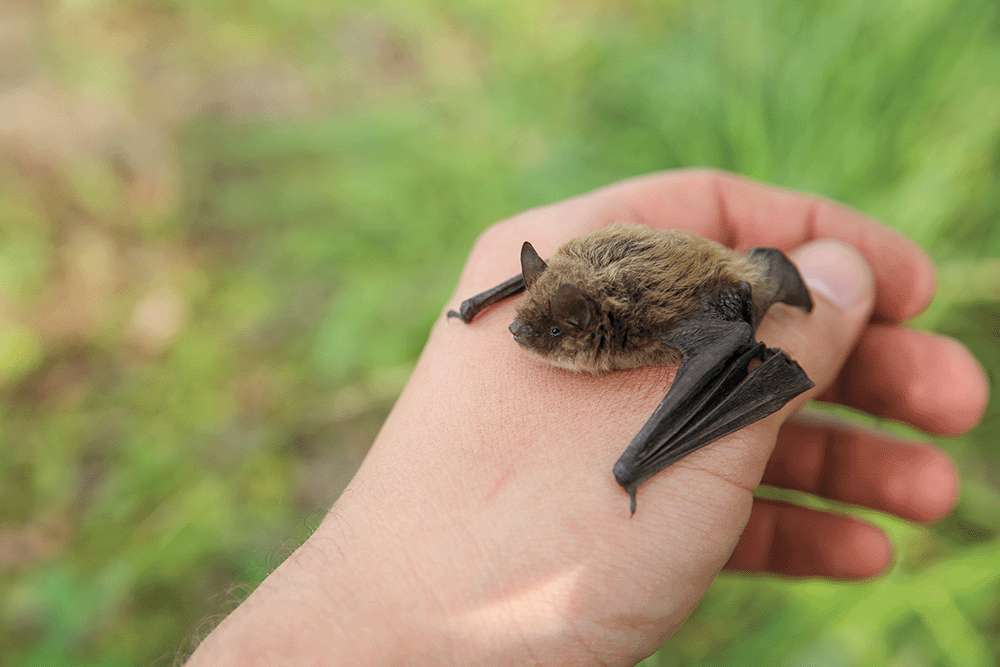
Walking home recently as it was getting dark I just caught a glimpse of a ‘flittermouse’. Those of you who know your operas will be familiar with Johann Strauss’ work Die Fledermaus. Both names refer to bats. So called because of their supposed similarity to mice and their flittering flight. They are not related to mice at all and are the only mammals who are capable of proper flight. They have generally had a bad press – due to Vampire stories or the superstitious belief that night fliers do evil deeds. Out of 1,200 species worldwide there is only one that sucks blood by biting livestock whilst they are asleep and drinking their blood. This bat is a Latin American species – very safely over there, not over here. In Britain bats are probably one of three species: the pipistrelle, the long-eared bat, and the serotine. All three species are crepuscular or nocturnal and feed on flying insects. Their flight is short and jerky and they make high pitched squeaky noises as they fly. In reality, bats do a great deal for the world – pollinating over 500 species of plants and do a fair bit for seed distribution.

The most interesting fact about bats is their sophisticated echolocation techniques. The echo of their squeaks help them build a picture of where they are and what else is there. This ability was not suspected until the late 18th century – it was just thought that they had spectacular night vision. After some very unpleasant experiments, the bats’ use of sound to build a picture of the world was confirmed in the late 19th century.
I was amazed to learn that a blind man from California called Daniel Kish taught himself echolocation at an early age by using clicks of his tongue to help him understand the environment he found himself in. He was even able to ride a bicycle fairly safely.

A bat is not a flying mouse, and a slow worm, Anguis fragilis, is actually a legless lizard. They are part of an essential group of creatures who work creating soil. By disposing of dead vegetation, the ‘decomposers’ which include earth worms, mice, wood lice and cockroaches, enable nutrients to return to the soil and create the friability which results in the essential medium for plants to grow. This ‘top soil’ consists of mineral particles from weathering rocks plus organic material and even a minute proportion of dead animals. Try growing anything in the rubble left by developers of new estates – after they have stripped off the top soil and sold it on.

made by JR&A Ransome of Ipswich 1832 – Science Museum, London
The slow worms are particularly fond of compost heaps – where there is not only a ready source of nutrition but welcome warmth and protection in the winter.
The bulk of the decomposition occurs in the autumn and winter when the plants die down and the leaves fall from the trees. If the ground is wet, bacteria and fungi also play an essential part in this re-cycling. If the ground is dry, the process takes much longer.

I keep a record of rainfall and this last August was record-breakingly dry. It has been very challenging, and depressing for gardeners especially those addicted to what has been described as ‘the English Obsession’ i.e. the lawn. Lawns have looked terrible. We are now used to ‘no mow May’ and the advice to leave untended patches of garden, but I was interested to read a long article by ecologist and naturalist Denis Owen published in 1959. As far back as that there were people writing about the useless fashion for having a lawn. Described as ‘suburban conceit’ and ‘a bourgeois construct’ – terms amusingly over the top. It was the invention of the lawnmower in 1830 by Edwin Beard Budding of Stroud which made possible the maintenance of patch of ‘waste of space’ lawn. I have a small lawn which not only makes a meandering path between my flowerbeds but is somewhere to sit in a comfortable chair, with a cup of tea and a good book. I have never used stuff to kill moss, or weed killer or fed my lawn. It is a very pleasing mix of grasses but also daisies and buttercups which have cunningly adapted to a short stem form so that they don’t get their heads cut off by a mower. There are plenty of insects on my lawn and I enjoy seeing blackbirds pecking for worms and grubs. If climate change with its droughts and water companies with their mismanagement make it impossible to have a lush, green lawn, I hate to think what will replace it. Concrete slabs? Decking? A wasteland of gravel? Hope not. And it was great to watch that once the rains arrived at the end of August, it only took 4 days for the lawns to start to recover.