
May is usually the sunniest month of the year — although this April broke records. June often brings a common weather phenomenon known as ‘the return of the Westerlies’ or ‘the European Monsoon’. This is when the wild, wet Atlantic winds which are currently being kept at bay burst through and begin to dictate the typical weather of the British summer. Bucketing down for Wimbledon, fetes and school sports days? A perennial topic of conversation! As Samuel Johnson said, ‘when two Englishmen meet, their first talk is of the weather, and they tell each other what each must already know, that it is hot or cold, bright or cloudy, windy or calm’.
Few common species make the world go round
Ken Thompson, ecologist, biologist and senior lecturer in Animal and Plant Sciences at Sheffield University, is a very amusing and accessible writer. His latest book, No Nettles Required, gently pokes fun at some of the advice given in the many wildlife gardening books and articles. Here is hard scientific data behind biodiversity in gardens. Even the smallest space can be made to welcome wildlife and add to biodiversity. An example is the garden created by my friend Ian Thorburn. He has even made space for edibles.
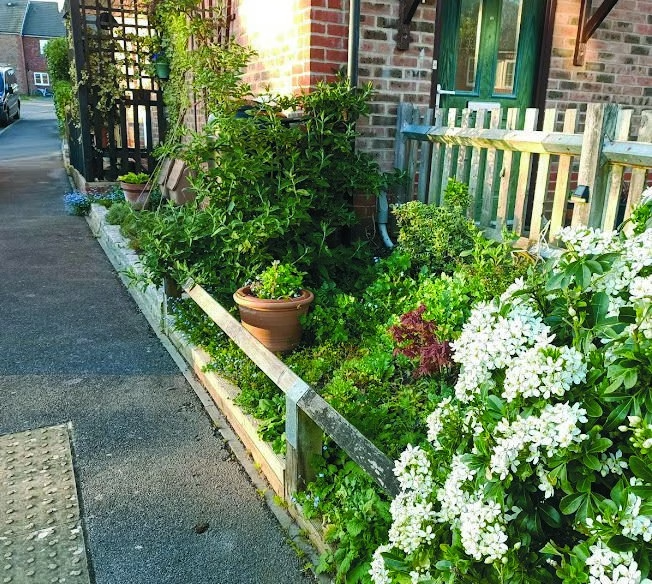
Studies have shown that the key is connectivity — one large nature reserve surrounded by no greenery is not as good as a network of gardens, verges and small patches of trees. Ken Thompson also writes that it is relatively few common species that make the world go round. It is these few common species that provide the framework and resources for the many rare ones, and the basic ecosystem services that are crucial for our survival.
A creature with a special place in our hearts
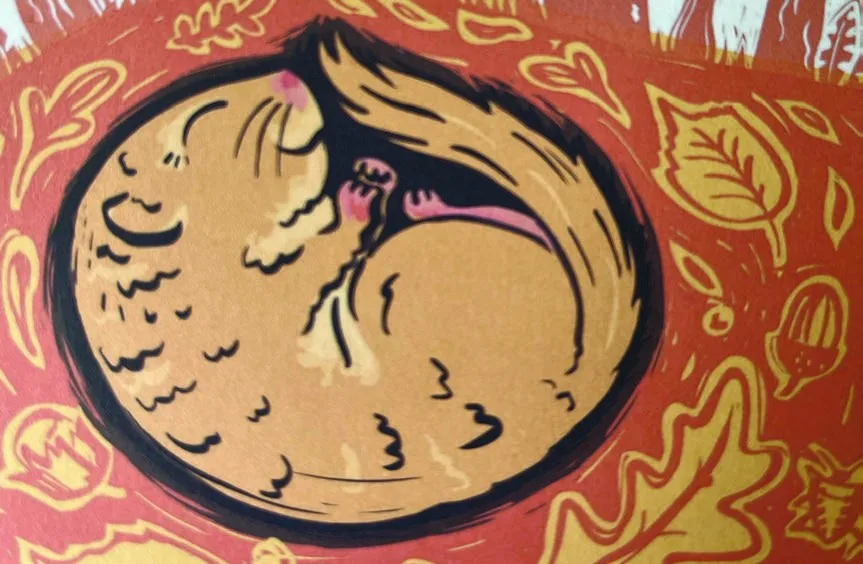
In the top 10 list of creatures which have a special place in our hearts, you’ll find dormice. Beatrix Potter always kept a pet dormouse. A dormouse features in the Mad Hatter’s Tea Party, curled up in a cup and muttering incoherently. Victorian school children would often have a dormouse in their pockets apparently — and would let them out at night.
Dormice are slumberous and secretive, nocturnal and arboreal, and so they are difficult to find. They spend two thirds of their lives in hibernation known as torpor, curled up and snoring gently. Dormice, as a species, have evolved beautifully in rhythm with the seasons. They are successional feeders: in early spring they feed on flowers of hawthorn and oak, before progressing on to honeysuckle and bramble. Over summer they alter their diet to include caterpillars, aphids and wasp galls. Towards the beginning of autumn they start to feed on bramble berries and hazel nuts.
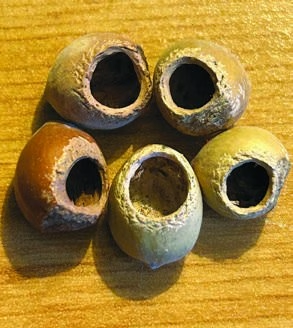
A clue that there are dormice about are the empty hazel nut shells which litter a woodland floor. They gnaw nuts in a characteristic way, leaving a smooth outer ring and tooth marks spiralling around the outside.
A disturbing decline
In about 1900 a survey was done on the range of dormice in England and Wales and it was found that the species was present in all the counties, right up to the Scottish Borders. Alas, the picture has changed. Attempts to map populations in the 1980s and 1990 showed a disturbing lack of dormouse activity. It was eventually concluded that they had declined from 35% of the counties and had shrunk to a range that encompassed Southern England and the Welsh Borders.
In 2016 the dormouse was declared extinct in 17 English counties — signalling a 72% drop since 1993. Habitat loss accounts for part of this situation. Climate change, with warmer winter months, can also make a difference. The dormice might come out of hibernation too early and not find the food they need to survive after a long winter fast. They will starve, not breed, and a whole generation is lost. The lesson here is that perfect adaptation to the seasons and the available resulting food is not such a good strategy. Adaptability is the key. Surrey is the top county for dormice — they are hanging on in patches of coppiced woodland, but for how much longer?
There is another species of dormouse which is earning for itself a reputation as a pest: the edible dormouse, or Glis glis. It is not a native and it is unclear when it first appeared over here from the Continent. It is larger than our hazel dormouse and has been seen in increasing numbers round Beaconsfield and Amersham — and it is gnawing electric wires and invading attics.
A tulip tree behind the church
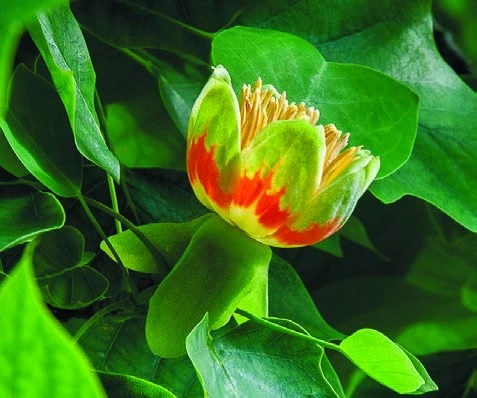
If you have a moment, walk round behind St Nicolas Church and admire a wonderful specimen of the tulip tree — liriodendron tulipifera. It comes into flower in June, showing large tulip-shaped flowers in green, streaked with orange. It comes originally from the east coast of the USA, and the pale wood was used in house interiors and the bark used as a heart stimulant.
Volunteers have met to start conservation work on Beryl Harvey Field. I hope to bring you more news next month.
This article first appeared in the June 2026 issue of Cranleigh Magazine. Pick up your free copy around the village, or read more at cranleighmagazine.co.uk.