
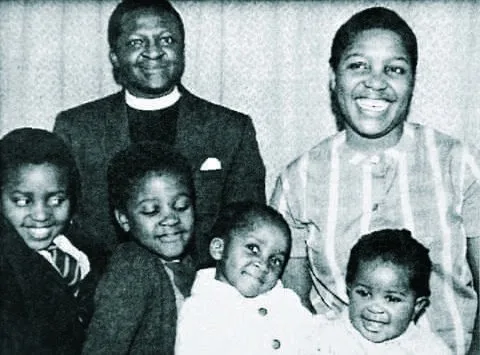
In the autumn of 1963 the St Nicolas parish magazine carried a letter of thanks from a holidaymaker who had spent a happy month in the village. The rector introduced him simply as ‘a South African clergyman’. His name was D.M. Tutu. Joy Horn revisits the visit, the Cranleigh he would have known, and the extraordinary life that lay ahead of him.
The rector, the Revd. Edward (Fred) Johnson, introduced this letter by describing D.M. Tutu as ‘a South African clergyman’ because he was not yet the internationally-known figure he later became. However, the Church of the Province of Southern Africa, into which Desmond Tutu had been ordained in 1960, had spotted his ability, and had sent him to study Theology at King’s College London, in the Strand. Eventually, he graduated with two degrees. In 1963 he was also serving as a curate in Golders Green. His wife Leah and their three daughters were in England with him.
A letter of thanks
This letter was published in the October 1963 issue of the parish church magazine:
Dear Rector,
May I, through the medium of your parish magazine, say ‘thank you’ to the people of Cranleigh for giving us such a happy and enjoyable holiday.
We take back with us only the happiest of memories – of strangers stopping to give us a cheery ‘Hello’ (something that last happened to us in our sunbathed home) of an old lady crossing the road to shake us by the hand to welcome us to her village; of transport generously put at our disposal; of friendly and helpful shopkeepers, who were not trying all the time to palm off dubious goods to unsuspecting visitors – I could go on, multiplying examples of your warm friendliness. We were sorry that we could not accept all your invitations to tea – but there were so many! ‘Thank you’ seems so inadequate an expression for your generosity and hospitality, but it expresses – sincerely – our deep and heartfelt thanks.
Yours sincerely,
D.M. Tutu
The rector explained that ‘a parishioner has kindly put the use of her house’ at the family’s disposal for the month of August. This house was number 103 Horsham Road. It is no longer standing, but has been replaced by Lansdowne Court.
Cranleigh in 1963
What was Cranleigh like, when the Tutu family visited in 1963? Principally, it was still rightly called a village. The population, as given in the Census of 1961, amounted to 6,495. By the next Census, in 1971, it had rocketed to about 10,000. There were no estates yet of Cranleigh Mead, Hitherwood, Summerfields and Parkmead. (The estates to the north and west were far in the future.) There was still a steam railway: perhaps the Tutu family used it to reach Cranleigh? It was only destined to last a little longer, though, and closed in 1965. So no Downs Link Path for them to explore.
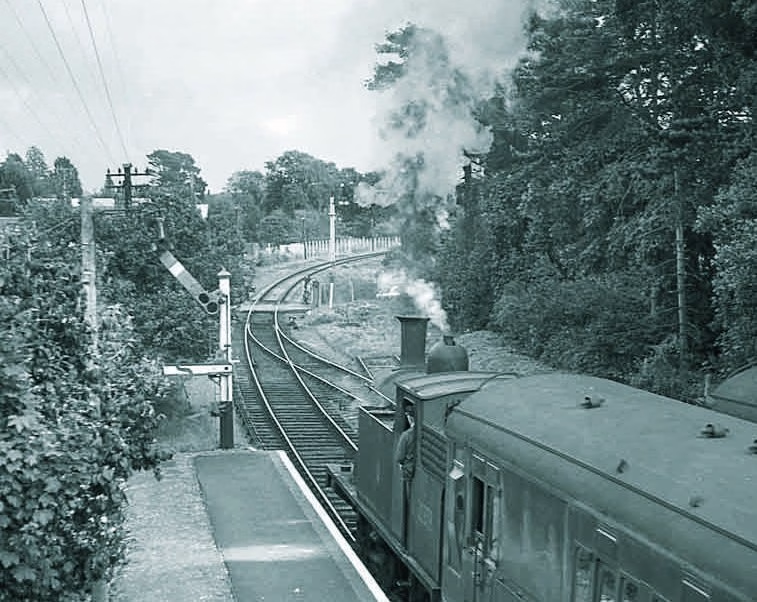
Supermarkets were a thing of the future, the nearest approximation to one being the Co-op, then in the High Street and a fraction of its present size. David Mann & Sons, founded in 1887, was the principal store, and the other shops were largely small independent ones. Of the business advertisements, it is interesting to note the ones which are functioning today: Pimm’s Funerals is still here, though now part of the Co-op; so is Hillman Atwell’s, but no longer under the Atwell family.
A church and a magazine of the time
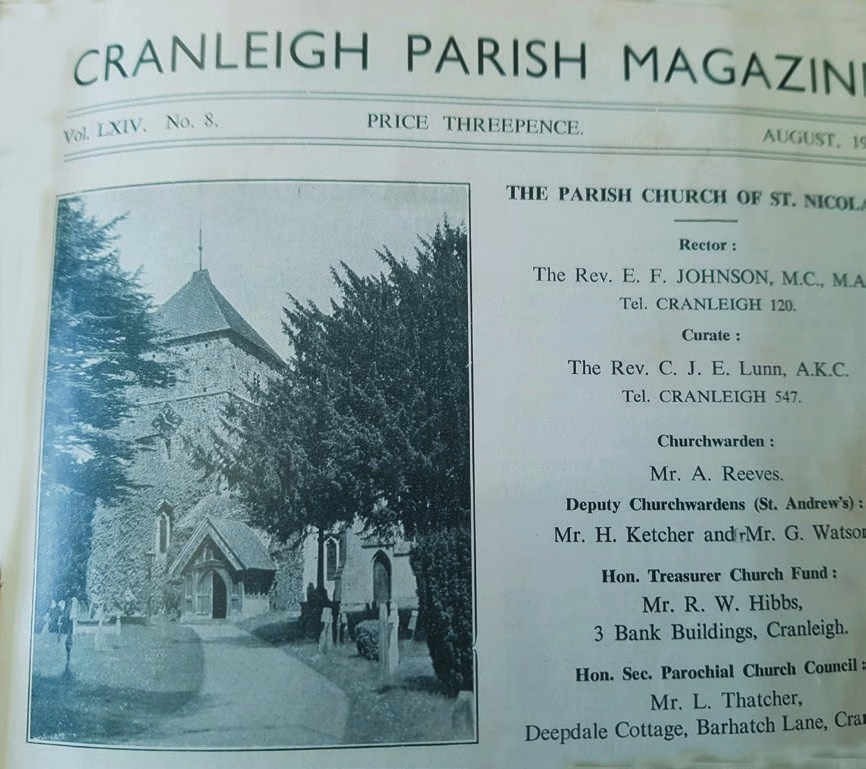
The cover of the parish magazine prompts a few observations. For one thing, the gravestones are looking much more perpendicular than they are today! Only one churchwarden is listed, as the other one, Jack Butcher, had recently died suddenly, on holiday in Italy. St Andrew’s church on the Common was active under St Nicolas church and had two deputy churchwardens. Not for much longer, though: in 1964, the decision was taken to close the church and it was demolished in the early 1970s.
The life that followed
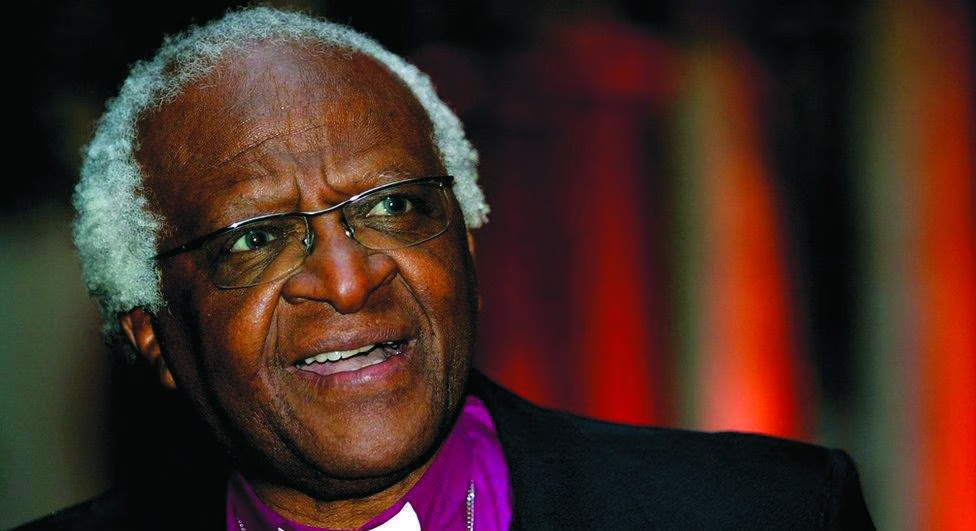
When Tutu returned to South Africa in 1966, with his B.Div. and M.Th. from King’s College London, he taught for a few years at the university of Botswana, Lesotho and Swaziland. He quickly became one of the most prominent opponents of South Africa’s apartheid system of racial segregation and white minority rule. He advocated non-violent protest and worked for foreign economic pressure to be applied to the white South African government.
He was awarded the Nobel Peace Prize in 1984 and became archbishop of Cape Town in 1986 – the first Black African to hold this top post. When Mandela was released in 1990 after 26 years in prison, he and Tutu worked closely together, and when Mandela was elected president of South Africa in 1994, he appointed Tutu chairman of South Africa’s Truth and Reconciliation Commission to investigate apartheid-era crimes. Tutu believed that ‘without forgiveness there can be no future for a relationship between individuals or within and between nations’.
There is a wide range of views on Tutu from critical to admiring, and some doubt persists as to the long-term effectiveness of the Truth and Reconciliation Commission. He will be remembered for his childlike exuberance and spontaneous laughter. We are glad that he had such a positive experience of harmonious race relations during his month’s visit to Cranleigh. Perhaps it contributed to his ideals when back in South Africa.
This letter of Desmond Tutu appeared in the St Nicolas Parish Magazine of October 1963, and a short note about it appeared in the February 2022 issue, just after his death. This article is a longer (and illustrated) version of that note. Grateful thanks go to Nicola Craven-Smith, church administrator of St Nicolas church.
The Cranleigh History Society meets on the second Thursday of each month at 8pm in the Band Room.
This article first appeared in the June 2026 issue of Cranleigh Magazine. Pick up your free copy around the village, or read more at cranleighmagazine.co.uk.