
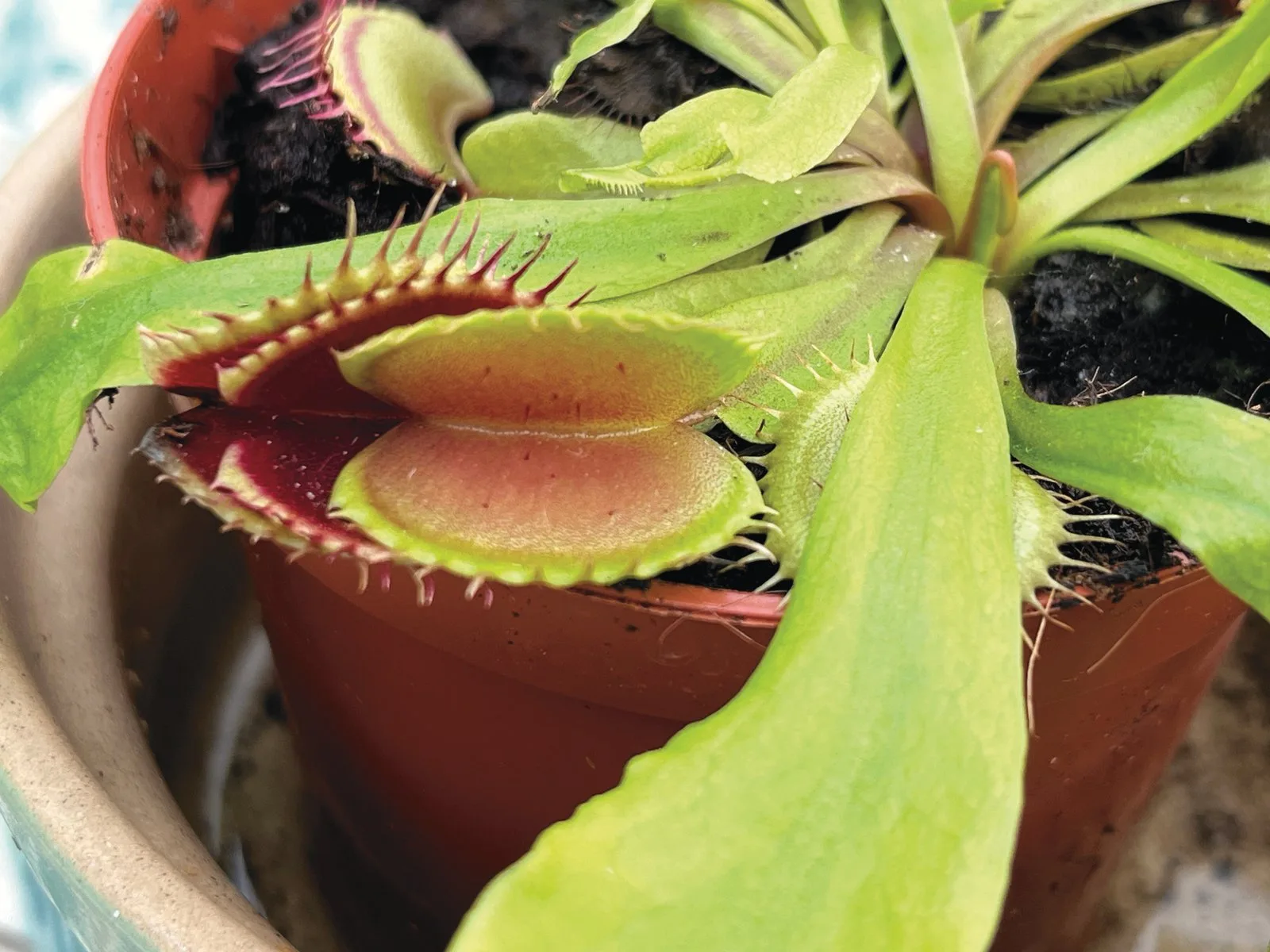
When did plants start eating meat? This evolutionary process has fascinated scientists throughout the centuries. It is a response to challenging soil conditions because in waterlogged swamps and acidic bogs which lack essential nutrients the plants sought nourishment elsewhere, and adapted to feed on fauna. Most content themselves with invertebrates but some pitcher plants can also digest small reptiles and frogs.
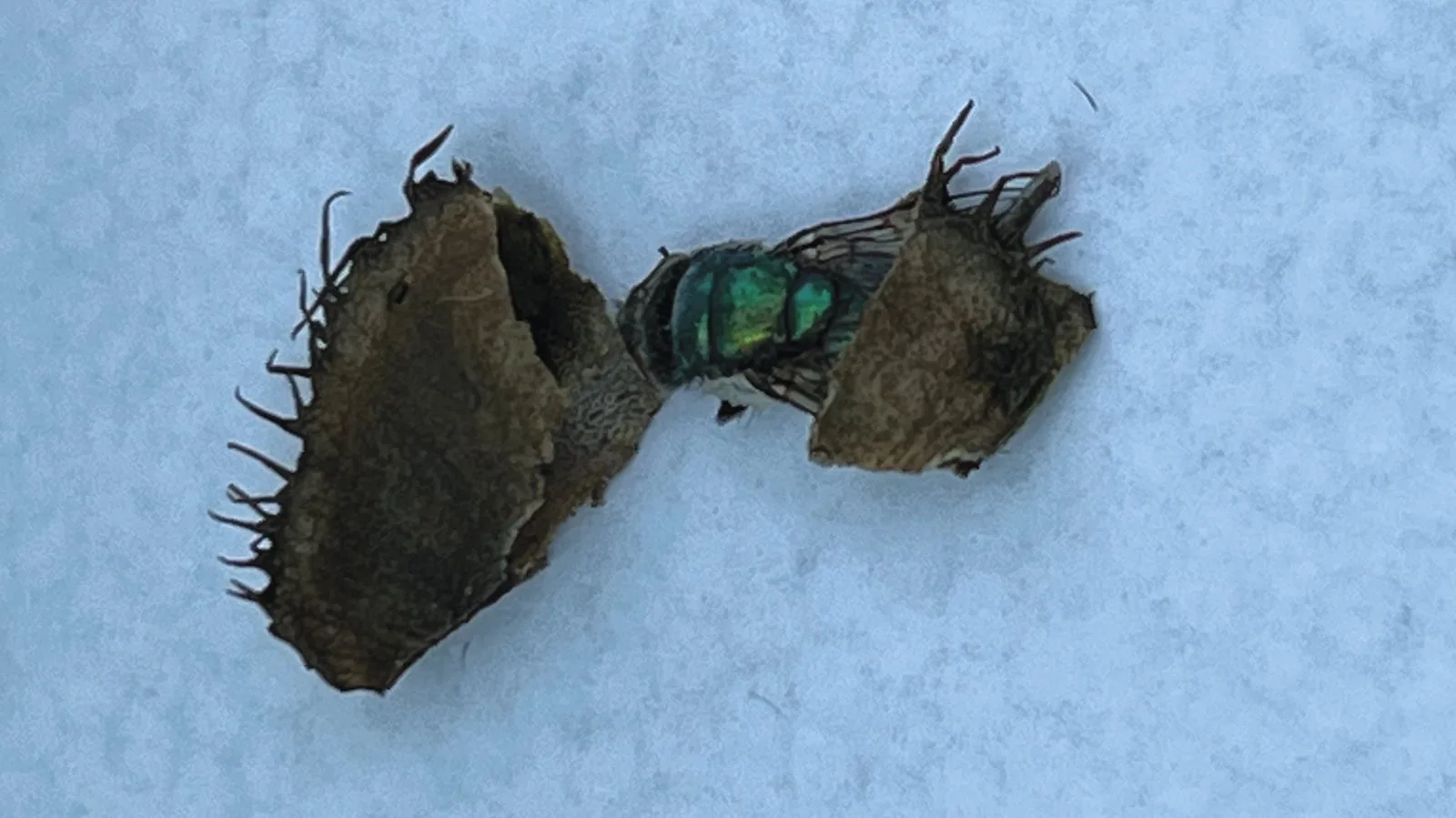
I suddenly had an outbreak of small flies on the plants on my kitchen windowsill and thought I’d deal with them biologically. A Venus Fly trap, I thought, and legged off to the nearest garden centre. These plants originate in the wetlands of North and South Carolina. The leaves have modified to form a trap sensitive to insect stimulation. The insect is attracted by a sweet smelling nectar, steps inside the leaf, stimulates the little trigger hairs and the leaf shuts, imprisoning the insect. The insect is then digested by special enzymes. My daughter Sam and I carefully cut open a trap and found a fly inside, as you can see from Sam’s photos.
In the UK we have three species of bug eating flora, each with a characteristic adaptation. Butterworts have a rosette of cup shaped leaves which secrete a slippery sticky fluid which traps insects.
Sundews have tendrils covering their leaves, tipped with sticky droplets. When an unsuspecting insect lands on the plant, the tendrils will curve inwards to ensnare it.
And the third species found in the UK is the Bladderwort, which floats on peaty pools. It has a tiny bladder on its stems, covered in miniscule hairs which opens a trap door to the bladder and then snaps it closed before the insect can escape. All three species excrete a special enzyme which digest the insect and then excretes the exoskeleton.
Nature’s versatility and ability to adapt to challenging circumstances is a Wild Wonder!
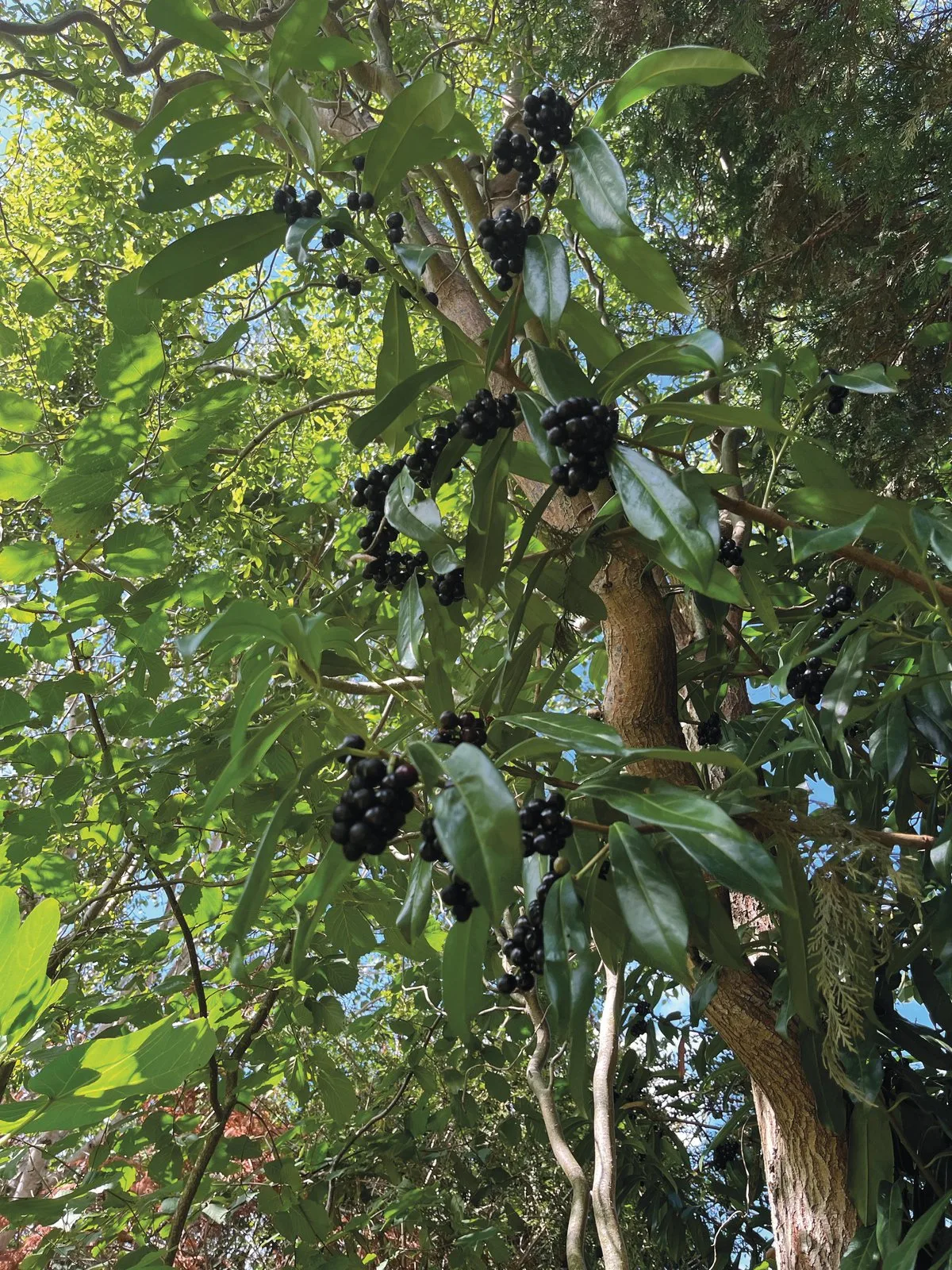
When not watching my fly trap, I have been very amused by the athletic antics of the pigeons. There is a laurel in the back of the garden next to mine. It has been allowed to grow into a tree and this year has produced a very heavy crop of berries. It is a Cherry Laurel and according to William Robinson of Gravetye Manor in Sussex, he finds it “a noble tree” for woodland. It forms a medium size tree with slender branches and bright green shining leaves. He was one of the earliest advocates for wild gardening and he hated laurels deformed by cutting and shaping. ‘Monstrosities’ he thundered, in his well-known uncompromising way. I can agree with him in a wild setting, but the cherry laurel is invaluable as a suburban hedge. If well cut it is a handsome sight, and it is evergreen and pollution resistant. And it can give that much prized commodity: privacy. And the bush grown as a tree has a lot going for it too, apart from its comedy value as a pigeon target. A native of Asia Minor and was introduced into Europe in about 1580 as an ornamental. It has sweet-smelling white flowers in the spring and berries which change from red to black as autumn approaches. It is not a true member of the Laurus family but belongs in the prunus category: Prunus laurocerasus. It needs to be treated with caution, though. Although it does not poison the soil round it as is sometimes thought, it is vigorous and outcompetes any plant which gets too close. There is something to the poison story though; the leaves and twigs, if crushed release hydrogen cyanide from the prussic acid in the sap which can be lethal. In fact, one is advised not even to burn green leaves or stems on an open fire.
What a wonderful boon shade was this year during the several heat waves. I found myself zigzagging up the road, from shade patch to shade patch to keep out of the sun. No walking ‘on the sunny side of the street’ for me. Another reason, with the changing climate, to value trees. I have made a video for My Cranleigh with Peter Morgan. I go for a walk round Cranleigh and mention some of my favourite trees. If you would like to view it, or a selection of videos about our beautiful Village, go to: https://mycranleigh.org.uk/topics/leisure-topics/green-spaces/trees-of-cranleigh
Finally apologies for getting the contact email address for Julia Reed wrong. It should be [email protected]. The next meeting of volunteers is the 2nd Sunday of October and if you would like to join the happy band of volunteers, email Julia for a chat.
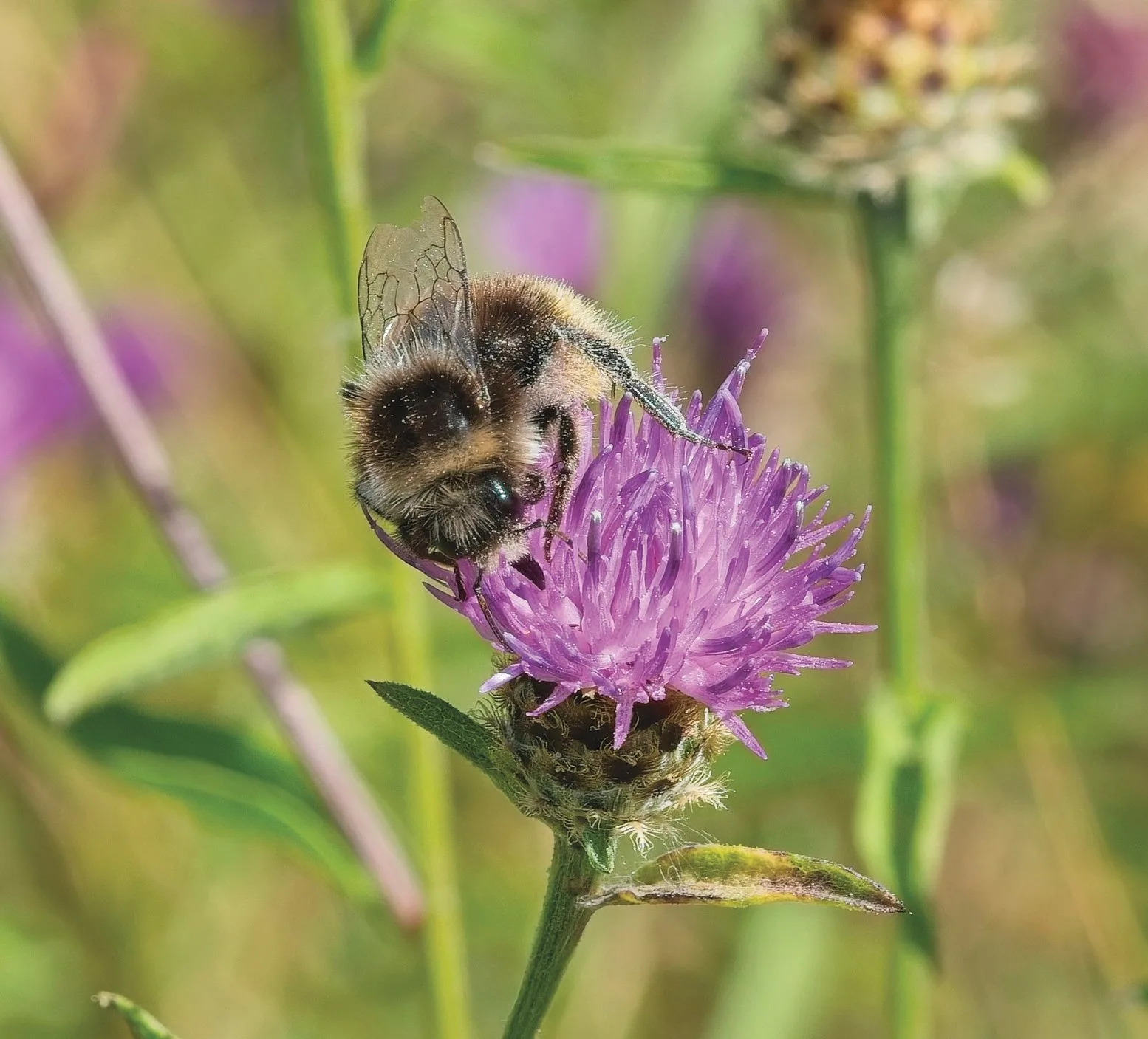
Finally a photograph taken by Mark Matthews of a bee feeding happily on Knapweed. No worries that the knapweed will feed on the bee.
This article first appeared in the October 2026 issue of Cranleigh Magazine. Pick up your free copy around the village, or read more at cranleighmagazine.co.uk.